Government Contract Accounting: The Complete Guide for Federal Contractors
Every year, thousands of small businesses win their first government contract and immediately make the same critical mistake: they assume their existing accounting system will work fine. After all, accounting is accounting, right? They’ve been tracking revenue, expenses, and profits for years. How different could government work be?
The answer: dramatically different. Government contract accounting operates under an entirely separate set of rules designed to ensure taxpayer dollars are spent appropriately. Contractors who don’t understand these rules face suspended payments, contract termination, and in severe cases, allegations of fraud. The Defense Contract Audit Agency (DCAA) doesn’t care that you’re a successful commercial business—if your accounting system can’t prove your costs are allowable, allocable, and reasonable, you’re not ready for government work.
This guide explains the core principles of government contract accounting in plain language. Whether you’re pursuing your first federal contract, struggling to understand why the DCAA rejected your accounting system, or trying to formalize the informal practices that worked when you were smaller, you’ll learn what government contract accounting actually requires and how to implement it correctly.
This isn’t just theory. Understanding these principles is the difference between a profitable government contracting business and one that loses money on every contract because indirect costs weren’t tracked properly. It’s the difference between sailing through DCAA audits and spending months remediating findings. Most importantly, it’s the foundation for sustainable growth in the government marketplace.
What Is Government Contract Accounting?
Government contract accounting is a specialized approach to financial management designed to satisfy federal regulations governing how contractors track, allocate, and report costs charged to government contracts. While commercial accounting focuses primarily on profitability and tax compliance, government contract accounting must prove that every dollar billed to the government is allowable under Federal Acquisition Regulation (FAR) rules, properly allocated to the correct contract, and reasonable given market conditions.
The fundamental principle is accountability. When a business charges costs to a government contract, they’re not just recording an expense—they’re making a claim against taxpayer funds. The government requires contractors to maintain accounting systems that can demonstrate, with documentary evidence, exactly how those costs were incurred and why they should be reimbursed or included in contract pricing.
This accountability framework exists because of historical problems with defense contracting. During World War II and the subsequent military buildup, the government discovered contractors were charging wildly inappropriate costs to contracts—personal expenses, lavish entertainment, costs that benefited commercial work but were charged to government projects. In response, Congress established detailed rules about what costs are allowable, how they must be tracked, and what accounting systems must demonstrate.
The regulatory framework for government contract accounting includes several key components:
Federal Acquisition Regulation (FAR) serves as the primary rule book, with Part 31 specifically addressing contract cost principles and procedures. FAR Part 31 defines which costs are allowable, which are unallowable, and how contractors must handle allocations.
Defense Federal Acquisition Regulation Supplement (DFARS) adds additional requirements for Department of Defense contracts, the largest segment of government contracting.
Cost Accounting Standards (CAS) provide detailed requirements for larger contractors to maintain consistency in how they estimate, accumulate, and report costs. While CAS only applies to contracts exceeding certain thresholds (generally $2 million for modified CAS coverage), the principles inform best practices for all contractors.
DCAA Audit Guidance interprets how these regulations apply in practice. The Defense Contract Audit Agency conducts audits and evaluates whether contractor accounting systems comply with these requirements.
The critical difference between commercial and government contract accounting is this: in commercial work, if you can justify an expense for tax purposes and it improves profitability, you’re probably fine. In government contracting, you must prove the expense is specifically allowable under FAR, properly allocated using a consistent methodology, and charged only to contracts that benefit from that expense. You can’t just “write it off”—you must be able to defend every allocation decision with documentation and logic.
This rigor makes government contract accounting more complex, but it also provides structure. Once you understand the rules and implement proper systems, government contracting becomes predictable. You know exactly what you can charge, how to allocate indirect costs, and what documentation you need. The contractors who struggle are usually those trying to retrofit commercial accounting practices rather than starting with a proper foundation.
The 5 Core Principles of Government Contract Accounting
Understanding government contract accounting starts with five fundamental principles. Every requirement, every DCAA audit question, and every compliance challenge traces back to these core concepts. Master these principles, and the details become much easier to manage.
Principle 1: Proper Cost Classification
Cost classification is the foundation of government contract accounting. Every expense your business incurs must be classified as either a direct cost or an indirect cost, and this distinction determines how you charge that cost to contracts.
Direct costs are expenses that can be specifically identified with a particular contract. When an engineer works exclusively on Contract A for a week, that engineer’s salary for that week is a direct cost to Contract A. When you purchase materials that will only be used on Contract B, those materials are direct costs to Contract B. Direct costs benefit a single contract, can be traced to that contract without ambiguity, and are charged directly to that contract’s cost pool.
Indirect costs are expenses that benefit multiple contracts or your business as a whole. Your rent benefits every project your team works on. Your HR manager’s salary supports all employees regardless of which contracts they work on. Your liability insurance protects the entire business. These indirect costs must be accumulated in pools and allocated to contracts using a rational methodology—you can’t simply guess or charge them arbitrarily.
The distinction matters enormously for contract pricing and billing. On cost-reimbursement contracts, properly classified direct costs can be billed as incurred. Indirect costs are billed using provisional rates that are later reconciled to actual costs. On fixed-price contracts, your bid must accurately reflect both direct and indirect costs or you’ll lose money when costs exceed your price.
Common classification mistakes cause serious audit findings. Contractors often misclassify costs as direct when they should be indirect (or vice versa) based on convenience rather than actual benefit. For example, charging a project manager’s entire salary to a single contract when they actually support multiple projects is misclassification—their time should be allocated as an indirect cost or tracked daily and charged based on actual hours worked per contract.
Another frequent error is inconsistency—treating similar costs differently without justification. If you charge one employee’s training as a direct cost to their primary contract but treat another employee’s identical training as an indirect cost, you’re creating an audit finding. The DCAA expects consistent treatment of similar costs.
The rule of thumb: if an expense can be specifically identified with a single contract and removing that contract would eliminate that expense, it’s likely direct. If the expense would continue even if you lost a particular contract because it supports your overall operations, it’s likely indirect. When in doubt, document your reasoning—the DCAA values consistency and logic more than any particular classification choice.
Principle 2: Accurate Cost Allocation
Once you’ve classified costs as direct or indirect, you must allocate them to contracts using a rational, consistent methodology. Cost allocation is how you determine what portion of your indirect costs should be charged to each contract.
The concept is straightforward: if your business has $500,000 in annual overhead costs (rent, utilities, administrative salaries, etc.) and you work on five contracts, you need a fair method to spread those $500,000 in costs across those five contracts based on the benefit each contract receives from your overhead infrastructure.
Allocation bases are the denominators you use for this calculation. The most common allocation bases in government contracting are:
- Direct Labor Hours: Total hours employees spend on direct contract work
- Direct Labor Dollars: Total wages paid for direct contract work
- Total Cost Input: All direct costs (labor, materials, subcontracts, etc.)
For example, if you choose direct labor dollars as your allocation base and Contract A represents 35% of your total direct labor dollars, then Contract A would be allocated 35% of your overhead costs (35% of $500,000 = $175,000).
The key is selecting an allocation base that reasonably reflects the causal or beneficial relationship between your indirect costs and your contracts. If you’re a labor-intensive professional services firm where contracts primarily consume employee time, direct labor hours or dollars makes sense. If you’re a manufacturing contractor where material costs dominate, total cost input might be more appropriate.
Indirect cost pools are the buckets where you accumulate different types of indirect costs before allocation. Most government contractors use a three-tier structure:
- Fringe Benefits: Employee-related costs like health insurance, retirement contributions, and payroll taxes
- Overhead: Facility costs, administrative salaries, supplies, utilities—costs related to running your operations
- General & Administrative (G&A): Executive salaries, accounting, legal, business development—costs related to managing the entire business
Each pool typically has its own allocation base. Fringe might allocate based on direct labor dollars. Overhead might allocate based on direct labor hours. G&A might allocate based on total cost input. The structure depends on your business model and what creates the most reasonable allocation.
Overhead rates are calculated by dividing your indirect cost pool by your allocation base. If you have $500,000 in overhead costs and $1,000,000 in direct labor dollars, your overhead rate is 50%. This means for every dollar of direct labor you charge to a contract, you also charge 50 cents of overhead.
Government contractors typically operate on provisional rates—estimates of what indirect rates will be for the year—and then reconcile to actual rates after year-end. If your provisional overhead rate was 50% but your actual costs resulted in a 48% rate, you owe the government a refund for the difference. If actual costs resulted in a 52% rate, the government owes you additional money. This reconciliation happens through the incurred cost submission process.
The DCAA pays close attention to cost allocation because it’s an area where contractors can manipulate numbers. Choosing allocation bases that shift costs toward more lucrative contracts, changing methodologies mid-year without disclosure, or failing to update rates regularly are all red flags. Your allocation methodology must be DCAA compliant, documented in writing, applied consistently, and defensible with clear logic.
Principle 3: Allowable vs. Unallowable Costs
Not all business expenses can be charged to government contracts. FAR Part 31 provides explicit guidance on which costs are allowable, which are expressly unallowable, and which require special handling. Understanding these distinctions prevents costly audit findings and potential false claims allegations.
Allowable costs are reasonable, allocable to the contract, and comply with FAR cost principles. Most ordinary business expenses fall into this category: employee salaries, rent, utilities, necessary supplies, business insurance, professional development, and similar costs that any business would incur.
Expressly unallowable costs are specifically prohibited by FAR Part 31.205. These include:
- Entertainment costs (31.205-14): Tickets to sporting events, amusement, concerts, theater, or social events cannot be charged to government contracts, even if they have a business purpose.
- Alcoholic beverages (31.205-51): Any costs related to alcohol are unallowable, whether purchased for client entertainment or employee celebrations.
- Lobbying costs (31.205-22): Expenses related to influencing legislation or government policy are unallowable, with limited exceptions for specific technical discussions.
- Certain legal costs (31.205-47): Legal fees related to defending fraud allegations, prosecuting claims against the government, or patent infringement are unallowable or limited.
- Public relations and advertising costs (31.205-1): General brand advertising and public relations are unallowable. Only specific types of advertising (recruiting, contract performance notification) are allowable.
- Bad debts (31.205-3): Write-offs of uncollectible accounts cannot be charged to government contracts.
- Contributions and donations (31.205-8): Charitable contributions are unallowable.
The consequences of charging expressly unallowable costs to government contracts are severe. At minimum, you’ll face audit findings and be required to repay the costs with interest. In egregious cases, you could face False Claims Act liability, suspension from government contracting, or criminal charges. Even innocent mistakes can trigger significant penalties if the DCAA determines your accounting system failed to prevent unallowable costs from being charged to contracts.
This is why proper chart of accounts structure is critical. Your accounting system should have specific account codes for unallowable costs, making it impossible to accidentally charge them to government contracts. For example, create a dedicated “Entertainment – Unallowable” account code that is excluded from all contract cost reports. When an employee submits an expense report including a baseball game, your accounting team codes it to the unallowable account and it never touches contract costs.
Some costs have allocability limitations rather than being fully unallowable. For instance, compensation for executives and highly-paid employees may be subject to caps. Travel costs must be reasonable (you can’t fly first class when coach is available). The DCAA will scrutinize these costs for reasonableness even when they’re technically allowable.
The best practice is maintaining a clear separation between allowable and unallowable costs from the moment expenses are incurred. Train employees on what costs can and cannot be charged to projects. Implement expense report review procedures that flag potentially unallowable items. Structure your accounting system to segregate these costs automatically. Prevention is far easier and cheaper than remediation after an audit.
Principle 4: Consistent Cost Accounting Practices
Consistency is a core principle of government contract accounting. The DCAA expects contractors to apply the same accounting practices, allocation methodologies, and cost treatment decisions from period to period. You can’t change how you account for costs simply because a different treatment would be more favorable for a particular contract or time period.
This principle prevents contractors from manipulating accounting to shift costs toward more lucrative contracts or time periods. Without consistency requirements, a contractor could classify certain costs as direct on cost-reimbursement contracts (where they’re fully recoverable) but treat the same costs as indirect on fixed-price contracts (where they’re buried in overhead). This would unfairly burden one customer while benefiting another.
Cost Accounting Standards (CAS) formalize consistency requirements for larger contractors. CAS is a set of 19 detailed standards that govern cost accounting practices for contractors meeting certain thresholds:
- Full CAS coverage applies to contracts exceeding $50 million in a fiscal year
- Modified CAS coverage applies when a single contract exceeds $7.5 million (or $2 million for small businesses) but total contracts don’t reach $50 million
Even contractors not subject to CAS should follow its principles. The DCAA uses CAS concepts when evaluating whether any contractor’s accounting practices are adequate, regardless of contract size.
Key CAS standards contractors should understand:
- CAS 401 (Consistency) requires consistent treatment of costs as direct or indirect
- CAS 402 (Consistency in Allocating Costs) requires consistent allocation methodologies
- CAS 405 (Accounting for Unallowable Costs) requires identifying and segregating unallowable costs
- CAS 406 (Cost Accounting Period) requires using consistent fiscal periods
For CAS-covered contractors, you must file Disclosure Statements (DS-1 or DS-2 depending on coverage level) that explain your cost accounting practices in detail. Once filed, you’re bound to those practices unless you formally disclose changes and obtain approval. Undisclosed changes to accounting practices can trigger significant financial adjustments.
Even for contractors not subject to CAS, consistency matters. If you’re treating similar costs differently or changing methodologies without documentation and justification, you’re creating audit risk. The DCAA may question whether changes were made to manipulate contract costs rather than for legitimate business reasons.
Document your accounting policies in writing. When you need to change a practice—perhaps you’re restructuring your indirect cost pools or changing allocation bases because your business has evolved—document why the change is necessary and implement it consistently going forward. Transparency and consistency create audit resilience.
Principle 5: Adequate Timekeeping and Labor Distribution
Labor costs are typically the largest expense for government contractors, making accurate time tracking the absolute foundation of compliant accounting. The DCAA scrutinizes timekeeping more than any other area because labor mischarges create cascading problems throughout contract accounting—direct costs are misstated, indirect rates are wrong, and contract pricing becomes unreliable.
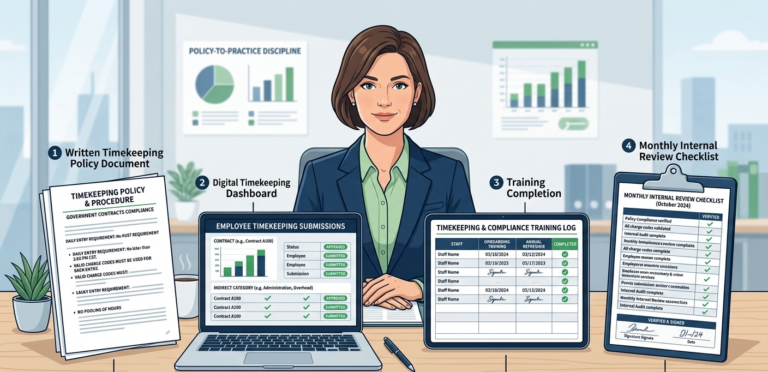
Daily time entry is not optional—it’s a DCAA requirement. Employees must record their time daily or contemporaneously with the work performed. “Contemporaneous” means at or near the time the work is done, not reconstructed days or weeks later from memory. The DCAA considers weekly or monthly time entry inadequate because it introduces estimation and reduces accuracy.
Why daily entry matters: memory degrades rapidly. By Friday afternoon, most people can’t accurately recall how they spent Monday morning. They round to convenient numbers (exactly 8 hours per day, neat divisions like 4 hours per project) rather than actual time worked. This estimation creates compliance violations because government contracts must be charged based on actual costs, not approximations.
Supervisory review and approval provides the oversight necessary to catch errors before they flow into accounting. The DCAA expects supervisors to review their team’s timesheets for reasonableness, accuracy, and proper charging. Supervisors should understand what work their team performed and verify time allocations make sense given project schedules and deliverables.
The review process must be documented. It’s not enough for a supervisor to glance at timesheets—there must be evidence they approved them. Many contractors fail DCAA floor checks because they can’t demonstrate supervisory approval actually occurred, even though they claim it did.
Labor distribution reports show how employee time is allocated across contracts, indirect activities, and leave. These reports are critical for:
- Verifying direct labor charges to specific contracts are accurate
- Calculating indirect rates based on actual labor consumption
- Supporting invoices and contract claims
- Demonstrating compliance during audits
A labor distribution report might show:
- Employee A: 120 hours Contract X, 40 hours Overhead, 0 hours Leave
- Employee B: 80 hours Contract X, 60 hours Contract Y, 20 hours Overhead, 0 hours Leave
- Employee C: 0 hours Direct, 160 hours Overhead, 0 hours Leave
These reports feed into overhead rate calculations. If you have 1,000 direct labor hours and 200 overhead hours in a month, your overhead burden as a percentage of direct labor is 20% (200÷1,000). This data directly impacts what you bill customers and what you charge to contracts.
Correction procedures are equally important. When time entry errors occur—and they will—you must have a documented process for making corrections that maintains audit trail integrity. The DCAA expects:
- Corrections can’t delete original entries—they must create new corrective entries
- Someone other than the employee should approve corrections (typically a supervisor)
- The reason for the correction must be documented
- Corrections should be infrequent (frequent corrections suggest inadequate controls)
Many contractors fail this requirement by allowing employees to simply change their timesheets after submission. This creates gaps in the audit trail and suggests weak controls. Instead, implement a correction workflow where proposed changes are submitted, reviewed, approved, and documented before being entered.
Leave tracking must also be rigorous. The DCAA wants clear separation between time worked on contracts and paid time off. You cannot charge vacation, sick leave, or holidays directly to government contracts—these are indirect costs that flow through your fringe benefit pool. Contractors sometimes try to charge 40 hours per week to contracts even when employees took leave, essentially billing the government for time not worked. This is fraud.
Your timekeeping system should integrate directly with your accounting system, eliminating manual data transfers that introduce errors. Hour Timesheet provides this integration specifically for government contractors, ensuring time flows accurately from employee entry through supervisor approval and into accounting with a complete audit trail. This integration is critical—disconnected systems create reconciliation problems that trigger audit findings.
The bottom line: if your timekeeping system doesn’t support daily entry, supervisory approval, comprehensive audit trails, and leave tracking, you’re not ready for government contract work. Labor accounting is too important to handle with spreadsheets or commercial time tracking tools that weren’t designed for DCAA requirements.
Key Government Contract Accounting Requirements
Beyond the five core principles, several specific requirements define what your accounting system must deliver. These requirements flow from FAR regulations and DCAA audit guidance, and failure to meet them can result in your accounting system being deemed inadequate—a determination that can suspend contract payments and prevent you from winning new work.
Your Accounting System Must Be DCAA Compliant
The DCAA evaluates contractor accounting systems using Standard Form 1408 (SF 1408), the Preaward Survey of Prospective Contractor Accounting System. This form outlines six fundamental criteria your system must meet:
1. Proper Segregation of Direct and Indirect Costs
Your system must clearly distinguish between costs that benefit specific contracts (direct) and costs that benefit multiple contracts or your general operations (indirect). This segregation must be visible in your chart of accounts and consistently applied.
2. Identification and Exclusion of Unallowable Costs
Your system must prevent expressly unallowable costs from being charged to government contracts. This typically requires dedicated account codes for unallowable cost categories and controls that exclude these accounts from contract cost accumulation.
3. Accurate Cost Allocation
Your indirect costs must be accumulated in logical pools and allocated to contracts using rational, documented methodologies. The DCAA will evaluate whether your allocation bases reasonably reflect the relationship between indirect costs and contract benefits.
4. Accumulation of Costs by Contract
Your system must track direct costs by individual contract, allowing you to report costs for Contract A separately from Contract B. This job costing capability is fundamental—if you can’t track costs by contract, you can’t bill cost-reimbursement contracts or verify fixed-price contract profitability.
5. Interim Cost Summaries
You must be able to produce cost summaries monthly (or more frequently) showing cumulative contract costs to date. Contractors who can only generate annual cost reports fail this requirement because they can’t support interim billing or monitor contract performance.
6. Acceptable Reconciliation Between Books and Records
Your contract cost reports must reconcile to your general ledger. If you’re reporting $500,000 in costs on Contract X in your billing, your general ledger must show $500,000 in costs accumulated for Contract X. Disconnects between systems create audit findings.
If the DCAA determines your accounting system doesn’t meet these criteria, they’ll issue a finding of “inadequate accounting system.” This has serious consequences:
- Payments on cost-reimbursement contracts may be suspended
- You may be unable to win new contracts requiring preaward accounting system approval
- You’ll face intense scrutiny on existing contracts
- You must remediate the deficiencies and undergo re-audit before restrictions are lifted
Prevention is critical. Before pursuing government contracts, ensure your accounting system is properly structured. Many contractors start with QuickBooks or similar commercial software, which can meet DCAA requirements if properly configured—but configuration is key. Simply using QuickBooks without DCAA-specific setup will fail audit.
This is why many contractors turn to DCAA compliant accounting systems purpose-built for government contracting. These systems implement required controls and reporting automatically, reducing the risk of inadequate system findings.
You Need an Adequate Timekeeping System
Your timekeeping system is separate from, but deeply integrated with, your accounting system. The DCAA conducts floor checks—on-site reviews of timekeeping practices—to verify your time tracking meets requirements:
- Daily or contemporaneous time entry by all employees
- Actual time worked, not estimates or budgets
- Supervisory review and approval with documented evidence
- Comprehensive audit trail showing original entries and any corrections
- Signed timesheets (electronic signatures acceptable) acknowledging accuracy
- After-the-fact changes prohibited or strictly controlled with documented justifications
The integration between timekeeping and accounting is critical. Time data must flow into your accounting system to:
- Create direct labor charges to specific contracts
- Calculate actual direct labor hours for overhead rate calculations
- Support payroll processing
- Generate labor distribution reports
Disconnected systems—where employees track time in one system and someone manually transfers data to accounting—create compliance risk. Manual transfers introduce errors, create reconciliation problems, and weaken audit trails. The DCAA expects seamless integration where approved time automatically flows into job costing.
Many contractors fail floor checks because their timekeeping systems are inadequate, even when their accounting systems are properly structured. Spreadsheets, basic time clocks, and commercial time tracking apps typically don’t provide the controls and audit trails the DCAA requires. Purpose-built solutions like Hour Timesheet were designed specifically to pass floor checks by enforcing daily entry, documenting supervisory approval, and maintaining immutable audit trails.
You Must Track Indirect Costs Separately
Your indirect cost pools must be structured logically and tracked separately from direct costs. Most contractors use a three-tier structure:
Fringe Benefits Pool
Accumulate employee-related indirect costs:
- Health insurance
- Retirement plan contributions
- Payroll taxes (employer portion)
- Life insurance, disability insurance
- Worker’s compensation insurance (allocated portion)
Fringe typically allocates based on direct labor dollars or direct labor hours. If your fringe pool totals $200,000 and you have $800,000 in direct labor costs, your fringe rate is 25% ($200,000 ÷ $800,000).
Overhead Pool
Accumulate costs related to running your direct operations:
- Rent and utilities
- Administrative and support staff salaries
- Office supplies and equipment
- Indirect labor (project managers, quality control)
- Depreciation on equipment
- Maintenance and repairs
- Small tools and supplies
Overhead typically allocates based on direct labor hours or dollars. If your overhead pool is $500,000 and you have 10,000 direct labor hours, your overhead rate is $50 per direct labor hour.
General & Administrative (G&A) Pool
Accumulate costs related to managing the entire business:
- Executive salaries
- Accounting and finance staff
- Legal fees
- Business development and marketing (allowable portions)
- Corporate insurance
- Professional services (consultants, auditors)
G&A typically allocates based on total cost input (all direct costs plus overhead, excluding G&A itself). If your G&A pool is $300,000 and your total cost input is $2,000,000, your G&A rate is 15%.
Why separate pools matter: Different indirect costs have different relationships to contract work. Fringe benefits track directly with labor. Overhead relates to the effort of running projects. G&A relates to running the entire business. Using separate pools with appropriate allocation bases creates more accurate contract costing than lumping everything together.
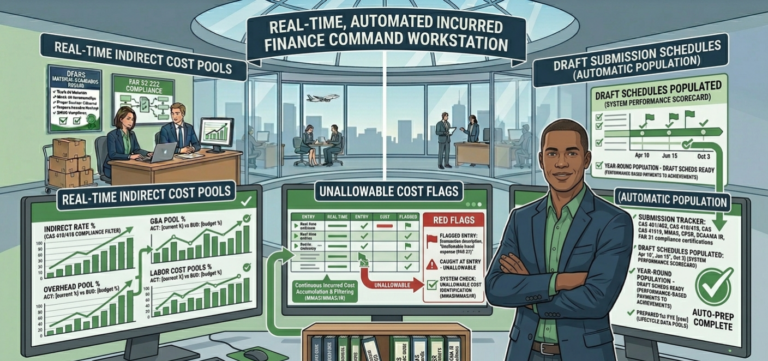
Provisional vs. Final Rates: Government contractors typically operate on provisional rates—estimates of what indirect rates will be for the year. These provisional rates are used for interim billing. After year-end, you calculate actual rates based on actual costs and actual allocation bases, then reconcile:
- If provisional rates were higher than actual rates, you owe the government a refund
- If provisional rates were lower than actual rates, the government owes you additional payment
This reconciliation happens through the incurred cost submission (ICS), also called the incurred cost proposal. You must submit your ICS within six months of fiscal year-end, showing actual costs incurred and calculating final indirect rates. The DCAA audits your ICS to verify costs are allowable and properly allocated, potentially adjusting your rates if they find issues.
You Need Strong Internal Controls
Internal controls are the policies and procedures that ensure your accounting system produces accurate, reliable data. The DCAA evaluates whether you have adequate controls to prevent errors and detect fraud.
Segregation of duties means no single person should control all aspects of a transaction. For example:
- The person who approves purchases shouldn’t be the same person who processes payments
- The person who creates invoices shouldn’t be the same person who records cash receipts
- The person who enters timesheets shouldn’t be able to approve their own time
This separation prevents fraud and errors. In small businesses where segregation is difficult, implement compensating controls like owner review of financial reports and bank reconciliations.
Approval authorities should be clearly defined. Who can approve expenditures? At what dollar levels? Who can approve timesheets? Who can approve journal entries? These approval requirements should be documented in writing and followed consistently.
Review and reconciliation procedures catch errors before they become problems:
- Monthly bank reconciliations
- Reconciliation between subledgers (job costing, accounts payable) and general ledger
- Reconciliation between timekeeping and payroll
- Review of contract costs versus budgets
- Monthly indirect rate calculations to monitor provisional vs. actual rates
Documentation requirements ensure you can support every transaction:
- Vendor invoices supporting accounts payable
- Receiving documents supporting inventory
- Purchase orders supporting commitments
- Approved timesheets supporting labor charges
- Contracts and task orders supporting revenue recognition
The DCAA expects you to maintain these documents for the life of the contract plus seven years. Electronic storage is acceptable, but documents must be readily retrievable.
Strong internal controls don’t just satisfy auditors—they protect your business. Controls prevent embezzlement, catch billing errors before you invoice customers, and identify cost overruns while you can still take corrective action.
Common Government Contract Accounting Mistakes
Even experienced contractors make accounting errors that trigger DCAA findings. Understanding these common mistakes helps you avoid them.
Mistake 1: Using Cash Basis Accounting
Many small businesses use cash basis accounting for simplicity and tax purposes. Cash basis records revenue when payment is received and expenses when paid. This works fine for commercial businesses and tax reporting.
Government contracts require accrual basis accounting. Accrual basis records revenue when earned (regardless of payment timing) and expenses when incurred (regardless of payment timing). This matching principle ensures contract costs reflect the period when work was performed, not when cash changed hands.
Why accrual matters for government contracts: Indirect rate calculations must reflect costs incurred during the fiscal year, not costs paid during the year. If you paid January rent in December, cash basis would record that rent in the wrong year, distorting your rates. Accrual basis records it in January when it belongs.
Similarly, cost-reimbursement contract billing must reflect costs incurred, not costs paid. You can bill for materials when received, not when you pay the vendor. You can bill for labor when performed, not when payroll runs.
How to transition: If you’re using cash basis for tax purposes, you can maintain two sets of books—cash basis for taxes, accrual basis for contract accounting. Most accounting software supports this with proper setup. Alternatively, transition entirely to accrual basis, which is generally recommended once you’re doing significant government contract work.
The key adjustments:
- Record accounts payable for unpaid vendor invoices
- Record accounts receivable for unbilled contract work
- Accrue expenses like rent, insurance, and utilities at period-end
- Defer prepaid expenses to match them to the correct period
Mistake 2: Inadequate Audit Trail
An adequate audit trail means you can trace any transaction from source documents through to financial reports, and reverse the process from financial reports back to source documents. Every transaction should show who entered it, when, and what supporting documentation exists.
Common audit trail failures:
- Deleting transactions rather than creating reversing entries
- Modifying historical records without documentation
- Manual adjustments without explanation or approval
- Missing source documents (no vendor invoice, no approved timesheet)
- Disconnected systems where data transfers create gaps
The DCAA needs complete audit trails to verify costs are legitimate and properly recorded. If you can’t trace a labor charge from timesheet entry through supervisor approval to job costing to general ledger to customer invoice, you have an audit trail problem.
How to fix this:
- Configure your accounting software to prevent deletion of posted transactions
- Implement approval workflows for journal entries and adjustments
- Maintain organized electronic or paper files of source documents
- Use integrated systems where time, expenses, and accounting flow seamlessly
- Train staff on documentation requirements
Mistake 3: Inconsistent Labor Charging
Labor mischarging is the most common DCAA finding. Contractors make several recurring mistakes:
Charging leave directly to contracts: When employees take vacation or sick leave, that time cannot be charged as direct labor to government contracts. Leave is an indirect cost that flows through your fringe benefit pool. Some contractors, wanting to hit 40 billable hours per week, charge leave directly to whatever contract the employee usually works on. This is fraud.
Estimating time instead of tracking actual: Employees must record actual time worked, not estimates based on budgets or percentages. If your timesheets show exactly 8 hours every day split into perfect percentages like 50/50 or 25/75, the DCAA will question whether this represents actual time or estimation.
Allowing backdated changes without controls: Employees can’t simply edit timesheets after submission without supervision and documentation. When Debbie realizes on Friday she coded Wednesday’s time to the wrong project, she can’t just change Wednesday’s entry—she needs supervisor approval and a documented reason for the correction.
Inconsistent treatment of similar employees: If you charge Employee A’s training as direct cost to their primary contract but treat Employee B’s identical training as an indirect cost, you’ve created inconsistency. Similar costs should receive similar treatment unless there’s a clear reason for different handling.
How to fix this:
- Implement strict leave tracking that excludes leave hours from direct contract charging
- Require daily time entry to reduce estimation
- Implement approval-based correction workflows
- Document your labor charging policies and train employees
- Use timekeeping software designed for DCAA compliance (like Hour Timesheet) that enforces these rules
Mistake 4: Poor Indirect Cost Allocation
Indirect rate calculations create significant problems when contractors:
Use incorrect allocation bases: Your allocation base should reflect the causal or beneficial relationship between indirect costs and contracts. If you’re allocating rent based on revenue, you’re creating arbitrary allocation—rent doesn’t vary with revenue. Direct labor hours or square footage would be more logical.
Fail to update rates regularly: You should calculate actual indirect rates monthly to compare against provisional rates. Waiting until year-end to discover your provisional overhead rate was 45% but actual was 52% means you’ve underbilled customers all year. Monthly monitoring lets you adjust provisional rates if actual costs diverge significantly from budget.
Mix unallowable costs into indirect pools: Unallowable costs cannot flow through indirect rates to be charged to government contracts. If your G&A pool includes $50,000 in entertainment expenses, you must remove those unallowable costs before calculating your G&A rate. Failure to do this means you’re billing unallowable costs indirectly, which is just as problematic as billing them directly.
Use single indirect rate when multiple pools are needed: If you have both professional staff and administrative staff, using a single overhead rate treats them identically. But professional staff typically work directly on contracts while administrative staff work indirectly. You may need separate overhead pools or more sophisticated allocation methodologies.
How to fix this:
- Review your allocation bases annually to ensure they remain appropriate as your business evolves
- Calculate actual rates monthly and compare to provisional rates
- Segregate unallowable costs from indirect pools
- Consider whether your business needs multiple indirect cost pools
- Document your indirect rate structure and allocation methodologies in your accounting manual
Mistake 5: Mixing Personal and Business Expenses
Contractors who use business accounts for personal expenses or vice versa create major DCAA red flags. The agency interprets this as weak internal controls and questions the reliability of your entire accounting system.
Common problems:
- Using company credit cards for personal purchases then coding them as business expenses
- Personal vehicle expenses claimed as business costs without adequate documentation
- Home office deductions claimed without proper allocation between business and personal use
- Family members on payroll performing little or no actual work
Even legitimate mixed-use expenses require careful allocation. If you work from home, you can allocate a portion of rent, utilities, and internet to business—but you must have documentation supporting the allocation percentage and be consistent.
How to fix this:
- Maintain complete separation between personal and business finances
- If business credit cards are used for personal expenses, code them to owner draw/equity, not business expense accounts
- Document all allocations between business and personal use with contemporaneous records
- Ensure all employees (including family members) have documented job descriptions and perform actual work
- Review expense reports carefully to identify and recode personal expenses
The DCAA views mixing personal and business expenses as a fundamental control failure. Even if the dollar amounts are small, this practice undermines auditor confidence in your entire accounting system.
How to Set Up Government Contract Accounting
If you’re preparing for government contract work, follow these implementation steps to establish a compliant accounting foundation.
Step 1: Choose DCAA Compliant Software
Your software selection is critical. You need systems that can:
- Segregate direct from indirect costs
- Track costs by individual contract
- Maintain comprehensive audit trails
- Support daily time entry with supervisory approval
- Generate labor distribution reports
- Calculate and track indirect rates
- Integrate timekeeping with accounting
Generic accounting software like QuickBooks, Xero, or FreshBooks wasn’t designed for government contract requirements. These platforms can be configured for DCAA compliance, but it requires expertise and careful setup. Many contractors using commercial software fail DCAA audits because they don’t realize their configuration is inadequate.
Your options:
- Purpose-built government contractor software (like Hour Timesheet for timekeeping, Deltek or Unanet for full ERP) provides built-in DCAA compliance
- QuickBooks Desktop + Hour Timesheet combines commercial accounting with DCAA-compliant timekeeping through seamless integration
- Properly configured commercial software can work if you have expertise in both the software and DCAA requirements
For detailed comparison of options, see our guide to DCAA compliant accounting systems.
The key: whatever you choose must integrate timekeeping with accounting. Disconnected systems create compliance risk and reconciliation headaches.
Step 2: Design Your Chart of Accounts Properly
Your chart of accounts is the foundation of your accounting system. For government contractors, structure it to support compliance:
Direct cost accounts by contract:
- Create separate account numbers for each active contract
- Use consistent numbering (e.g., 4000-series for direct labor, 5000-series for direct materials)
- Include subaccounts for different direct cost types (labor, materials, subcontracts, travel)
Example structure:
- 4100 – Direct Labor – Contract A
- 4200 – Direct Labor – Contract B
- 5100 – Direct Materials – Contract A
- 5200 – Direct Materials – Contract B
Indirect cost pool accounts:
- Create separate account ranges for Fringe, Overhead, and G&A pools
- Within each pool, create detailed accounts for different cost types
Example structure:
- 6100-6199: Fringe Benefits Pool (health insurance, retirement, payroll taxes)
- 6200-6299: Overhead Pool (rent, utilities, indirect labor, supplies)
- 6300-6399: G&A Pool (executive salaries, accounting, legal, marketing)
Unallowable cost accounts:
- Create dedicated accounts for expressly unallowable costs
- Use account naming that clearly identifies unallowability (e.g., “6950 – Entertainment – Unallowable”)
- Configure reports to exclude these accounts from contract cost accumulation
Revenue accounts by contract:
- Track revenue separately by contract to monitor profitability
- Include both billed and unbilled revenue accounts for accrual basis reporting
A well-designed chart of accounts makes compliance easier by automatically segregating costs into the right categories. Resist the urge to oversimplify—proper granularity supports better analysis and cleaner audit trails.
Step 3: Establish Timekeeping Procedures
Document your timekeeping policies in writing and train all employees:
Daily entry policy:
- Require employees to enter time daily or at least contemporaneously
- Define “contemporaneous” (ideally same day, maximum 2-3 days)
- Specify consequences for non-compliance
What employees must record:
- Actual hours worked (not rounded to 8.0 per day)
- Specific contract or indirect activity codes
- Leave taken (vacation, sick, holidays)
- Brief descriptions of work performed (optional but helpful)
Approval workflow:
- Define who approves whose time (typically direct supervisor)
- Require approval before time flows to accounting/payroll
- Specify approval timing (e.g., within 2 business days of submission)
- Document how approvers verify accuracy
Correction procedures:
- Prohibit direct editing of submitted timesheets
- Require correction requests with justification
- Require supervisor approval of corrections
- Maintain audit trail of original entry and correction
System requirements:
- Use software that enforces daily entry Hour Timesheet was built specifically for this
- Configure the system to lock prior periods after payroll processes
- Enable audit logging to track all entries and changes
Train employees during onboarding and annually thereafter. Make it clear that accurate time charging is a compliance requirement, not optional.
Step 4: Create Internal Controls
Document your internal control procedures:
Approval authorities:
- Who can approve purchases at what dollar levels?
- Who can approve journal entries?
- Who can approve timesheets?
- Who can approve expense reports?
Segregation of duties:
- Separate purchasing from payment processing
- Separate billing from cash receipt recording
- Separate timesheet entry from payroll processing
- For small businesses where full segregation isn’t possible, implement owner review of key reports and reconciliations
Monthly close procedures:
- Bank reconciliations
- Subledger to general ledger reconciliation
- Contract cost review vs. budgets
- Indirect rate calculations (actual vs. provisional)
- Review of aged accounts receivable and payable
Documentation standards:
- What supporting documentation is required for each transaction type?
- How long are documents retained?
- Where are documents stored (electronic vs. physical)?
- Who is responsible for maintaining document files?
Written procedures serve two purposes: they ensure consistent application of controls and they demonstrate to auditors that you have a structured approach to financial management.
Step 5: Document Your Policies
Create an accounting policies and procedures manual that documents:
- Your fiscal year and accounting period structure
- Chart of accounts organization and definitions
- Direct vs. indirect cost classification criteria
- Indirect cost pool structure and allocation bases
- Unallowable cost identification and exclusion procedures
- Timekeeping requirements and procedures
- Internal control procedures
- Month-end and year-end close procedures
- Contract costing and billing procedures
This manual serves multiple purposes:
- Training document for new accounting staff
- Reference guide for existing staff
- Evidence of systematic approach for DCAA auditors
- Basis for consistency when questions arise
Update your manual annually or whenever you make significant changes to your accounting practices. If you’re subject to CAS, your Disclosure Statement should align with your accounting manual.
Step 6: Train Your Team
Everyone needs training on government contract accounting requirements:
Accounting staff need deep training on:
- Government contract accounting principles
- Your specific chart of accounts structure
- Internal control procedures
- How to generate required reports
- How to respond to DCAA audits
Managers and supervisors need training on:
- Timesheet review and approval requirements
- How to identify labor mischarging
- Expense report review for unallowable costs
- Their role in maintaining internal controls
All employees need training on:
- Daily time entry requirements
- How to code time to contracts vs. indirect activities
- Leave reporting requirements
- What costs cannot be charged to government contracts
- Expense report requirements
Conduct initial training during onboarding and refresher training annually. Document that training occurred (sign-in sheets, completion certificates) as evidence of your compliance efforts.
Training creates a compliance culture where employees understand why these requirements matter, not just what the requirements are. When employees understand that improper time charging can lead to False Claims Act liability, they take their responsibilities more seriously.
Cost Accounting Standards (CAS): What You Need to Know
Cost Accounting Standards (CAS) are a set of 19 detailed accounting standards that apply to certain government contractors. While not all contractors are subject to CAS, understanding its principles is valuable because the DCAA uses CAS concepts when evaluating any contractor’s accounting system.
When Do CAS Requirements Apply?
CAS coverage depends on contract dollar thresholds:
Full CAS Coverage:
- Applies when your business receives a single CAS-covered contract exceeding $50 million
- Requires compliance with all 19 CAS standards
- Requires filing a CASB Disclosure Statement (DS-2)
Modified CAS Coverage:
- Applies when you receive a single CAS-covered contract exceeding $7.5 million (or $2 million for small businesses)
- BUT your total CAS-covered contracts don’t exceed $50 million in your fiscal year
- Requires compliance with five specific CAS standards (401, 402, 405, 406, and 407)
- Requires filing a CASB Disclosure Statement (DS-1)
CAS-Exempt:
- Contracts under the thresholds above
- Firm-fixed-price contracts under $2 million
- Contracts for commercial items
- Small businesses receiving contracts under $2 million
Even if you’re CAS-exempt, the principles behind CAS standards represent best practices for government contract accounting.
Key CAS Standards
While there are 19 CAS standards total, several are particularly important for understanding government contract accounting:
CAS 401 – Consistency in Estimating, Accumulating, and Reporting Costs Requires that you use the same cost accounting practices for estimating, accumulating, and reporting costs. If you estimate a proposal treating training as indirect, you must accumulate actual training costs as indirect, and report them as indirect. You can’t change treatment arbitrarily based on what’s most advantageous.
CAS 402 – Consistency in Allocating Costs Incurred for the Same Purpose Requires that similar costs be treated consistently. You can’t charge one employee’s travel as direct to their primary contract while treating another employee’s identical travel as indirect. Similar costs in similar circumstances should receive similar accounting treatment.
CAS 405 – Accounting for Unallowable Costs Requires identifying unallowable costs and excluding them from billing, claims, and proposals. You must have procedures to identify expressly unallowable costs and segregate them in your accounting system.
CAS 406 – Cost Accounting Period Requires using a fiscal year as your cost accounting period and maintaining consistency in that period. You can’t change fiscal years arbitrarily to manipulate indirect rates.
CAS 407 – Use of Standard Costs for Direct Material and Direct Labor Allows use of standard costs (predetermined amounts) rather than actual costs for certain purposes, but requires variance analysis and adjustments.
Disclosure Statements
CAS-covered contractors must file Disclosure Statements describing their cost accounting practices in detail:
DS-1 (Modified CAS): Simpler form focusing on the five CAS standards applicable to modified coverage
DS-2 (Full CAS): Comprehensive form describing all cost accounting practices
The Disclosure Statement binds you to the practices described. If you want to change a practice, you must file a formal disclosure of the change. Undisclosed changes can trigger cost accounting practice changes that require retroactive contract price adjustments—potentially costing you millions if the change is deemed noncompliant.
Why CAS Matters Even If You’re Exempt
While CAS formally applies only to larger contractors, its principles represent logical, defensible cost accounting practices. The DCAA uses CAS concepts when evaluating any contractor’s system:
- Consistency (CAS 401, 402)
- Excluding unallowable costs (CAS 405)
- Using rational allocation bases (CAS 410)
- Properly structuring indirect cost pools (CAS 418)
Following CAS principles, even when not required, creates a stronger, more defensible accounting system. When audit questions arise, you can reference CAS standards to support your practices, demonstrating you’re following recognized government contracting principles.
Working with DCAA: What to Expect
The Defense Contract Audit Agency (DCAA) is the government organization that audits contractor accounting systems and contract costs. Understanding the DCAA’s role and how to work with them productively is essential for government contractors.
The DCAA’s Role
The DCAA performs several types of audits:
Preaward Accounting System Survey: Before awarding certain contracts (particularly cost-reimbursement contracts), the contracting officer may request a DCAA review of your accounting system using SF 1408. The DCAA evaluates whether your system meets the six criteria for adequacy. If your system is inadequate, you won’t receive the contract.
Floor Checks: DCAA floor checks are on-site reviews of your timekeeping practices. Auditors visit unannounced, interview employees about how they track time, review timesheets and supporting documentation, and verify your timekeeping system meets requirements. Floor checks typically last 1-2 days.
Incurred Cost Audits: After fiscal year-end, you submit an incurred cost proposal showing actual costs incurred on cost-reimbursement contracts. The DCAA audits this submission to verify costs are allowable, allocable, and reasonable. They examine supporting documentation, test internal controls, and may adjust costs if they find issues.
Proposal Audits: When you submit cost proposals for new contracts, the DCAA may audit your proposed costs to ensure they’re based on reasonable estimates and comply with FAR requirements.
Contract Closeout Audits: When contracts are completed, the DCAA may audit final costs to ensure proper closeout and determine if any adjustments are needed.
Preparing for a DCAA Audit
Preparation is the key to successful DCAA audits:
Maintain organized documentation:
- Keep all source documents readily accessible (vendor invoices, timesheets, contracts, purchase orders)
- Organize files logically (by fiscal year, by contract, by transaction type)
- Use electronic document management if possible for quick retrieval
- Maintain documents for contract life plus seven years
Know your accounting system:
- Understand how your chart of accounts is structured and why
- Be able to explain your indirect cost allocation methodologies
- Know how time flows from employee entry through approval to accounting
- Understand your internal control procedures
Reconcile everything:
- Ensure contract cost reports reconcile to general ledger
- Ensure timekeeping hours reconcile to payroll hours
- Ensure indirect rate calculations use correct bases
- Don’t wait for audit requests—maintain ongoing reconciliation
Assign a point person:
- Designate someone (usually CFO or controller) as primary DCAA contact
- This person coordinates document requests and auditor access
- Having a single point person prevents confusion and mixed messages
How to Respond to Audit Findings
When the DCAA identifies issues, respond professionally and promptly:
Understand the finding:
- Ask questions if you don’t understand what the auditor found
- Request specific examples and supporting analysis
- Don’t get defensive—focus on understanding the issue
Provide additional information:
- Sometimes findings result from auditor misunderstanding
- Provide additional documentation or explanation that clarifies the situation
- Be factual and professional in your responses
Agree when appropriate:
- If the finding is legitimate, acknowledge it
- Explain how it occurred
- Outline corrective actions you’ll implement
Disagree when justified:
- If you believe the finding is incorrect, professionally explain why
- Provide supporting documentation and regulatory citations
- Request a meeting to discuss the issue if needed
Implement corrective actions:
- Fix identified problems promptly
- Document corrective action plans in writing
- Demonstrate in follow-up audits that issues were resolved
Building a Good Relationship with DCAA
While the DCAA is an audit agency (not a consultant), you can build a productive working relationship:
Be responsive: When auditors request documents or information, provide it promptly. Delays create suspicion that you’re hiding problems.
Be cooperative: Make space available for on-site audits. Treat auditors professionally. Answer questions directly and honestly.
Be organized: Nothing impresses auditors more than a contractor who has documentation ready, systems well-organized, and explanations clear. Preparation demonstrates control.
Be proactive: Fix problems when you discover them, even before an audit. Self-reporting issues and showing corrective actions demonstrates good faith.
Don’t be defensive: View audits as opportunities to strengthen your system, not personal attacks. Accept constructive feedback and implement improvements.
The DCAA’s job is protecting taxpayer interests by ensuring contract costs are legitimate. When you maintain compliant systems and respond professionally to audits, most interactions are straightforward and not adversarial.
Government Contract Accounting Best Practices
Beyond meeting minimum requirements, these best practices create stronger, more audit-resilient accounting systems:
Implement Systems Before You Need Them
Don’t wait until you win your first contract to establish compliant accounting. Implement proper systems while you’re pursuing opportunities so you’re ready from day one. Trying to implement systems while performing contract work is chaotic—you’re learning compliance requirements while also trying to deliver on contracts. You’ll make mistakes that trigger audit findings.
Set up DCAA-compliant timekeeping, structure your chart of accounts properly, establish indirect rate structures, and document procedures before contract award. This preparation also makes you more competitive—contracting officers favor contractors with adequate accounting systems already in place.
Reconcile Indirect Rates Monthly
Don’t wait until year-end to calculate actual indirect rates. Perform monthly calculations comparing actual rates to provisional rates. If you budgeted 50% overhead but actual is running 55%, you need to know early so you can:
- Increase provisional rates going forward (with customer notification)
- Investigate why overhead is higher than expected
- Take corrective action if possible
- Avoid year-end surprises
Monthly rate monitoring also helps you recognize pricing problems early. If your overhead is spiking, perhaps you need to adjust your bidding strategy or reduce indirect costs.
Document Everything
“If it’s not documented, it didn’t happen” is the DCAA’s unofficial motto. Document:
- Why you made accounting policy decisions
- How you calculated indirect rates
- Why you changed allocation bases
- How you determined cost classification
- Meeting notes discussing contract accounting issues
- Training provided to employees
This documentation protects you during audits. When auditors question a decision from three years ago, documentation shows your reasoning and demonstrates systematic decision-making rather than arbitrary choices.
Separate Personal from Business Expenses
Maintain absolute separation between personal and business finances. This practice:
- Strengthens internal controls
- Increases auditor confidence in your system
- Simplifies tax compliance
- Protects you from commingling issues
Even if you’re a small business owner using personal credit cards occasionally for business expenses, code them correctly and reimburse yourself formally. Don’t muddy the waters between business and personal.
Train Employees from Day One
Don’t assume employees understand government contract accounting requirements—train them during onboarding:
- Why daily time entry matters
- How to code time correctly
- What constitutes unallowable costs
- Why accuracy is critical (compliance, not just convenience)
Employees who understand the “why” behind requirements follow them more consistently than those who just get a list of rules.
Use Purpose-Built Software
While you can configure commercial accounting software for DCAA compliance, purpose-built solutions make compliance easier and reduce risk. Hour Timesheet, for example, was designed specifically to meet DCAA timekeeping requirements—it enforces daily entry, documents supervisory approval, maintains audit trails, and generates labor distribution reports automatically.
Using purpose-built tools means:
- Compliance features work out-of-the-box
- Updates incorporate changing DCAA guidance
- Support teams understand government contracting requirements
- Integration with accounting is designed for contractor workflows
The cost difference between generic and purpose-built software is usually modest, and the reduced compliance risk justifies the investment.
Work with Government Contractor CPAs
Not all accountants understand government contract accounting. Work with a CPA firm experienced in government contracting who can:
- Review your accounting system setup
- Advise on indirect cost structures
- Prepare your incurred cost submissions
- Represent you during DCAA audits
- Help you respond to audit findings
Experienced government contractor CPAs have relationships with DCAA auditors, understand what triggers findings, and can help you avoid common mistakes. Their fees are an investment in compliance and audit protection.
Stay Current on FAR Changes and DCAA Guidance
FAR regulations and DCAA audit guidance evolve. The DCAA periodically issues Information for Contractors (IFC) bulletins explaining their interpretation of requirements. Major FAR changes can affect allowability, allocation, or reporting requirements.
Stay informed by:
- Subscribing to government contracting newsletters
- Attending industry association webinars (like NCMA or NCCA)
- Working with consultants or CPAs who track regulatory changes
- Reviewing DCAA’s public guidance documents
Don’t wait for an auditor to tell you about new requirements—proactive monitoring lets you adjust before issues arise.
Conclusion: Government Contract Accounting Isn’t Optional
Government contract accounting is fundamentally different from commercial accounting. The stakes are higher, the rules are stricter, and the consequences of noncompliance are severe. Contractors who treat government work like commercial work inevitably face DCAA audit findings, payment suspensions, and potential fraud allegations.
But contractors who invest in proper systems from the beginning find government contracting predictable and profitable. When you understand the five core principles—cost classification, cost allocation, allowability, consistency, and adequate timekeeping—the details become manageable. When you implement compliant systems before you need them, you avoid the chaos of trying to fix problems during audits.
The investment in proper accounting systems pays for itself quickly. DCAA-compliant timekeeping prevents labor mischarging that could trigger False Claims Act liability. Proper indirect rate structures ensure you’re not losing money on contracts because overhead was underestimated. Strong internal controls catch errors before they become audit findings. The cost of Hour Timesheet or similar tools is trivial compared to the cost of suspended contract payments or remediation after a failed audit.
Start with the right foundation. Structure your chart of accounts for government contracting. Implement daily timekeeping with supervisory approval and comprehensive audit trails. Segregate unallowable costs. Document your policies and procedures. Train your team on why compliance matters, not just what the rules are.
Then monitor continuously. Calculate indirect rates monthly. Reconcile contract costs to general ledger. Review timesheets for accuracy and reasonableness. Keep documentation organized and readily accessible. Treat every day as though a DCAA auditor might arrive tomorrow—because they might.
Next Steps: Strengthen Your Accounting Foundation
Ready to ensure your accounting system meets government contract requirements?
- Download our DCAA Compliance Checklist – Evaluate your current system against the six SF 1408 criteria
- Read our guide to DCAA compliant accounting systems – Compare solutions and find the right fit for your business
- Start your free Hour Timesheet trial – Implement DCAA-compliant timekeeping in days, not months
- Learn about surviving DCAA floor checks – Understand what auditors look for and how to prepare
Government contract accounting doesn’t have to be overwhelming. With the right knowledge, proper systems, and consistent practices, you can build an accounting foundation that not only satisfies DCAA requirements but also provides the financial visibility you need to grow your contracting business profitably.