How to Build a DCAA-Compliant Hour Timesheet Process for Government Contracting Teams
For companies in Government Contracting, timekeeping is not just an HR or payroll task. It is a core internal control that directly affects labor charging, invoice accuracy, indirect rate calculations, and audit readiness. A weak Hour Timesheet process can lead to misallocated labor, delayed billing, compliance findings, and unnecessary risk during a DCAA review. A strong process, by contrast, helps protect revenue, improve accountability, and build credibility with contracting officers, prime contractors, and auditors.
For small business owners, the challenge is creating a process that is both compliant and practical. Your team needs a system that employees will actually use, managers can monitor, and finance can rely on. If your organization provides outsourced accounting, contract administration, ERP implementation, or compliance support for government contractors, this is also an opportunity to reinforce your value proposition: helping clients build disciplined, audit-ready back-office processes that support growth.
If your goal is stronger DCAA Compliance, your timekeeping procedures should be intentional, documented, and consistently enforced. This article explains how to build a reliable, audit-ready timesheet process that aligns with DCAA expectations while remaining manageable for growing contractors.
Why a DCAA-Compliant Hour Timesheet Process Matters
In most government contracting businesses, labor is one of the largest cost drivers. Every hour worked can affect project costing, contract profitability, invoice support, and incurred cost submissions. That is why DCAA auditors often focus closely on timekeeping. They want to see whether employees record time daily, whether labor is charged to the correct direct or indirect account, and whether the company maintains controls over edits, approvals, and corrections.
A dependable Hour Timesheet process helps your business:
- Accurately allocate direct and indirect labor
- Support provisional billing, payroll, and final cost reporting
- Reduce audit findings, questioned costs, and corrective action plans
- Improve manager visibility into labor usage across contracts
- Demonstrate operational maturity to customers, primes, and lenders
For small business owners pursuing long-term success in Government Contracting, these controls are not optional. They are part of building a scalable operation that can withstand growth, system changes, and audit scrutiny. If your company offers accounting systems, advisory services, or compliance solutions for contractors, this is exactly where your services can make a measurable difference.
Start with a Written Timekeeping Policy
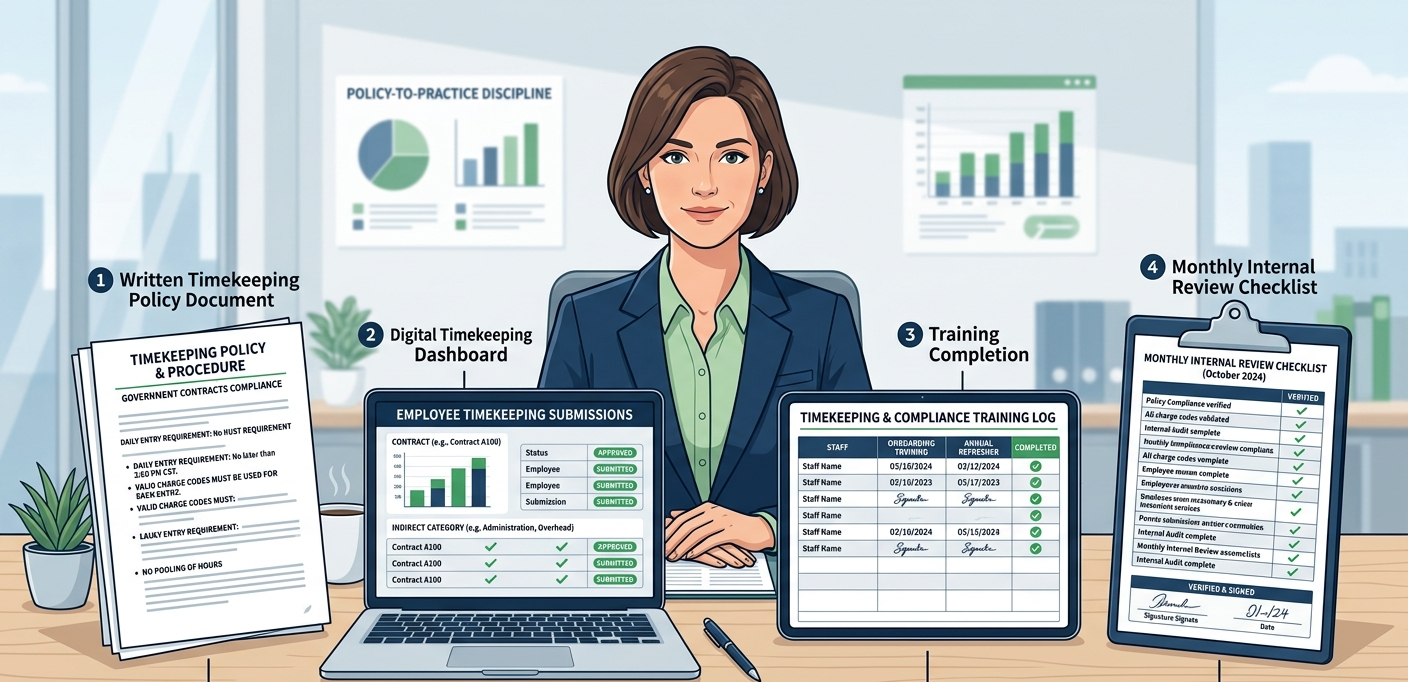
The foundation of DCAA Compliance is a clear, written timekeeping policy. Employees should never have to guess how or when to record time. Your policy should define expectations in plain language and explain the rules for entry, review, approval, and corrections.
Your policy should address the following:
- Employees must record all hours worked each day
- Time must be charged to the correct contract, task, project, or indirect account
- Supervisors may review timesheets for reasonableness, but they must not prepare them on behalf of employees
- Changes to submitted timesheets must be documented, approved, and traceable
- Falsification or improper charging of labor is prohibited and subject to disciplinary action
A strong policy also explains how to handle leave, holidays, overtime, uncompensated overtime if applicable, and work performed across multiple contracts in a single day. The more specific the policy, the easier it is to train employees and enforce consistent behavior.
If your business helps government contractors with compliance documentation, this is a valuable service area. Many small contractors know they need better controls but lack the internal bandwidth to write policies that align with real-world operations. A well-designed policy can become the starting point for stronger accounting, payroll, and labor distribution processes.
Require Daily Time Entry
One of the most important elements of a compliant Hour Timesheet process is daily time entry. Employees should record time as work is performed, not at the end of the week from memory. Reconstructed timesheets are less reliable, more error-prone, and more likely to raise concerns during an audit.
Daily time entry improves accuracy and reduces the chance that labor will be charged to the wrong contract or indirect account. This matters even more when employees split time between funded contract work, business development, internal meetings, proposal support, and administrative tasks.
For example, a project manager who spends the morning supporting a federal contract, an hour on internal operations, and part of the afternoon assisting with a bid effort should record those hours to the proper charge codes that same day. Waiting until Friday increases the risk of miscoding and weakens the audit trail.
To support this requirement, use a digital system that makes compliance easier. Features such as automated reminders, mobile access, intuitive charge code selection, and approval notifications can significantly improve adoption. If your company provides timekeeping software, ERP consulting, or outsourced back-office support, this is where your solution should be positioned as a way to simplify compliance rather than add administrative burden.
Define Direct and Indirect Labor Charging Clearly
Many timekeeping problems are caused by confusion, not misconduct. Employees need clear guidance on the difference between direct and indirect labor. In Government Contracting, that distinction affects cost accounting, billing, and indirect rate calculations.
Direct labor generally refers to work performed specifically for a contract, task order, or funded customer project. Indirect labor typically includes activities such as administration, internal meetings, training, recruiting, business development, and other support functions that benefit the business as a whole.
To improve DCAA Compliance, maintain a current list of charge codes with plain-language descriptions. Employees should know:
- Which contracts and tasks they are authorized to charge
- Which indirect accounts to use for non-contract work
- How to handle overtime, leave, holidays, and uncompensated overtime if applicable
- Who to contact when they are unsure how to charge time
It is also helpful to provide real examples. For instance, attending a required internal cybersecurity training may be indirect labor, while configuring a system specifically for a client contract may be direct labor. These examples reduce guesswork and improve consistency across departments.
If your organization supports contractors with accounting advisory or outsourced controller services, helping clients define labor charging rules is a high-value offering. Clear charge code structures do more than support compliance; they improve job costing and make contract performance easier to manage.
Use a System with Audit Trail Controls
A compliant process requires more than collecting hours. Your system must preserve a reliable audit trail. Whether you use dedicated timekeeping software or an integrated ERP platform, the system should show who entered time, when it was entered, what changes were made, and who approved those changes.
Strong system controls should include:
- Unique user logins for each employee
- Date- and time-stamped entries and submissions
- Restricted ability to edit previously submitted timesheets
- Documented explanations for corrections
- Supervisor approval workflows
- Reporting that supports labor distribution and review
These controls are essential in a defensible DCAA timekeeping environment. Spreadsheets, informal email approvals, and manual edits can create gaps that are difficult to defend during an audit. A modern system should also integrate with payroll and accounting tools so approved labor data flows cleanly into downstream processes.
If your company offers implementation, system integration, or managed accounting support, this is a natural point to highlight your value. Businesses often do not need more software alone; they need a properly configured process that aligns the system, policy, approvals, and reporting. Consider linking readers to your relevant service page, such as DCAA compliance support or government contractor accounting services.
Train Employees and Supervisors Regularly
Even the best policy will fail without training. Every employee should receive timekeeping training at onboarding, and existing staff should receive periodic refreshers. Supervisors need additional guidance because their role in reviewing and approving timesheets is critical.
Training should cover:
- The importance of accurate daily time entry
- How to select the correct charge code
- What to do if a mistake is discovered
- The difference between reviewing and altering employee time
- The compliance and legal risks of improper labor charging
Short, practical training is often more effective than a one-time policy handout. Consider using onboarding checklists, annual certifications, manager-specific workshops, and quick-reference guides inside your timekeeping system. For remote or hybrid teams, recorded training modules can help ensure consistency across locations.
Document all training sessions, attendance, and materials. In a DCAA Compliance review, training records help show that management has communicated expectations clearly and reinforced them over time. If your business offers compliance consulting, employee training can be positioned as an ongoing service that strengthens internal controls while reducing the burden on leadership.
Implement a Formal Correction Process
Mistakes happen. What matters is how your organization corrects them. A compliant Hour Timesheet process should allow corrections, but only through a controlled, transparent method that preserves the integrity of the original record.
Your correction procedure should require:
- The original entry to remain visible or recoverable in the system
- A reason for the change
- Employee acknowledgment of the correction
- Supervisor review and approval when appropriate
- Timely updates to downstream labor and billing records if needed
For example, if an employee accidentally charges two hours to overhead instead of a direct contract task, the correction should include documentation explaining the error, evidence of employee acknowledgment, and an updated posting to the appropriate labor record. What should never happen is a silent edit with no explanation or approval trail.
Unauthorized or undocumented changes are a major red flag in a DCAA review. If your company provides outsourced accounting or compliance oversight, helping clients establish a formal correction workflow can significantly reduce risk and improve confidence in labor reporting.
Monitor Compliance with Internal Reviews
Creating the process is only the first step. To maintain DCAA Compliance, management should perform periodic internal reviews of timekeeping activity. This becomes even more important as your business grows, wins new contracts, or adds remote employees and subcontractor oversight responsibilities.
Internal reviews can include:
- Checking whether employees submit timesheets daily and on time
- Reviewing labor charges for unusual patterns or miscoding
- Testing whether approvals occur as required
- Verifying that corrections include proper support
- Comparing timekeeping records with payroll and labor distribution reports
These reviews help identify small issues before they become larger compliance problems. They also demonstrate active management oversight, which is a key sign of a mature control environment. For small business owners, even a simple monthly review can provide meaningful protection against recurring errors.
If your firm offers fractional CFO, controller, or internal audit support, this is another area where your services can provide immediate value. Many contractors do not need a full in-house compliance team, but they do need periodic monitoring, reporting, and corrective action guidance.
Align Timekeeping with Payroll, Job Costing, and Billing
Your Hour Timesheet process should never operate in isolation. It should connect directly to payroll, project accounting, indirect rate calculations, and invoicing. Misalignment between systems often creates reconciliation issues, billing delays, and questions about the reliability of labor data.
Business owners should work with finance, HR, and operations teams to ensure:
- Approved timesheets flow accurately into payroll
- Labor costs are posted to the correct contracts and indirect pools
- Billing calculations reflect approved labor only
- Any adjustments are tracked and reconciled promptly
For example, if payroll is processed from unapproved timesheets or labor corrections are not updated in the accounting system, your invoices and job cost reports may no longer match the underlying record. That can create avoidable issues during contract reviews or incurred cost preparation.
An integrated approach reduces manual intervention and strengthens your overall control environment. If your company provides outsourced accounting, ERP integration, or end-to-end back-office support for government contractors, this is an ideal place to show how your services help clients connect timekeeping, payroll, project costing, and billing into one dependable workflow. You can also direct readers to a related resource such as contact us for a process review or system assessment.
Conclusion
A strong DCAA-compliant timekeeping process is one of the smartest investments a government contractor can make. It protects revenue, supports audit readiness, improves billing accuracy, and reinforces trust in your financial data. For small business owners focused on growth in Government Contracting, the goal is not simply to collect hours. It is to build a disciplined system that employees understand, managers enforce, and auditors can follow.
By establishing a written policy, requiring daily entry, clarifying labor charging, maintaining audit trails, training your team, and monitoring adherence, you create a practical path to lasting DCAA Compliance. A well-controlled Hour Timesheet process does more than satisfy requirements. It helps your organization operate with the precision, consistency, and credibility that government work demands.
If you need help designing or improving your timekeeping controls, now is the time to act. Whether you need system implementation, policy development, employee training, outsourced accounting, or broader compliance support, the right partner can help you strengthen your process before an audit or contract issue exposes weaknesses. Explore your service options, review your current workflow, and take the next step toward a more reliable and audit-ready operation.