
Teaming Agreement Risks: Avoiding Affiliation Issues in DCAA Audits
A teaming agreement that wins you a contract can also be the document that costs you your small business status — if it’s not structured correctly.
I’ve seen it happen to contractors who did everything else right. They had compliant timekeeping, a clean accounting system, and a solid past performance record. They teamed with a larger, more experienced prime to pursue a set-aside contract, won the award, and started performance. Eighteen months later, an SBA size protest triggered a review of the teaming arrangement. The work share provisions, the management control language, and the financial interdependencies in their agreement created an affiliation finding. The small business set-aside was voided. The contract was at risk. And DCAA was now looking at every cost submission filed under a size status that had just been called into question.
Teaming is one of the most powerful business development tools available to small government contractors. It is also one of the least understood from a compliance perspective. The contracting strategy and the regulatory framework operate on entirely different tracks — and when they collide during an audit, the consequences reach well beyond the teaming arrangement itself.
Let me walk you through the risks, the regulations, and how to structure your teaming agreements to stay out of trouble.
The Legal Foundation
Teaming agreement compliance sits at the intersection of SBA affiliation rules, FAR subcontracting requirements, and DCAA cost accounting obligations. Understanding all three frameworks is essential because a deficiency in any one of them can trigger exposure across the others.
13 C.F.R. Part 121 governs SBA size standards and affiliation rules for small business set-aside contracts. Under these regulations, two or more firms may be considered affiliated — and therefore combined for size determination purposes — when one controls or has the power to control the other, or when a third party controls or has the power to control both. The critical word is “power.” Affiliation can be found even when control is never actually exercised, if the teaming agreement’s language creates the structural conditions for control. A teaming agreement that gives the prime contractor approval authority over the subcontractor’s key personnel, financial decisions, or technical approach is a document that SBA — and by extension DCAA — will examine closely.
FAR 9.601 through 9.603 establishes the federal framework for contractor team arrangements. FAR 9.603 is direct: the government will recognize the validity of teaming arrangements provided they don’t violate antitrust laws or create other compliance concerns. What FAR doesn’t do is protect a contractor from the downstream audit consequences of a poorly structured teaming agreement. Winning a contract through a team arrangement creates cost accounting obligations for both the prime and each subcontractor — and those obligations run independently, regardless of how the team is structured commercially.
FAR 52.219-14, the Limitations on Subcontracting clause for small business set-asides, requires that the small business prime perform a specified percentage of the work with its own employees. For services contracts, that threshold is generally at least fifty percent of the cost of contract performance incurred for personnel. Here’s what contractors miss: this clause creates a direct link between your teaming agreement’s work share provisions and your DCAA cost submissions. If your teaming agreement assigns work in a way that causes your firm to fall below the performance threshold, your cost certifications and your size status are simultaneously compromised.
The SBA’s affiliation rules guidance and the DCAA Contract Audit Manual, Chapter 6 together provide the most complete picture of how these two oversight frameworks interact during an audit.
Where Teaming Agreements Create Compliance Risk
This is where audits go sideways: contractors treat the teaming agreement as a business development document and hand it to a contracts attorney only after the protest or audit has already started. By then, the language has been in place for months or years, costs have been accumulated and billed under the arrangement as structured, and unwinding the compliance exposure requires reconstructing decisions that were made long before anyone was thinking about DCAA.
The first risk area is control language. Teaming agreements that give the prime contractor approval rights over the subcontractor’s hiring decisions, project management approach, or financial commitments create structural affiliation risk under 13 C.F.R. Part 121. This language often enters agreements through boilerplate coordination provisions that seem reasonable from a project management perspective — the prime wants to ensure the subcontractor’s team is qualified and their approach is aligned. But the regulatory test isn’t whether control was exercised. It’s whether the agreement created the power to control.
The second risk area is work share provisions that don’t survive performance. A teaming agreement may specify that the small business prime will perform sixty percent of the work — satisfying the Limitations on Subcontracting clause on paper — but actual task assignments during contract performance erode that percentage as the work evolves. When DCAA audits the incurred cost submission and maps labor charges by contractor, a prime that billed at sixty percent but performed at thirty-five percent has a cost certification problem embedded in every submission filed during that period.
The third risk area is financial interdependency. Teaming arrangements that involve shared facilities, shared accounting systems, shared lines of credit, or intercompany loans between the prime and subcontractor create affiliation indicators that go beyond the teaming agreement itself. DCAA auditors reviewing a subcontractor’s accounting system for adequacy will look at whether the system is genuinely independent — or whether it is operationally dependent on the prime in ways that compromise the integrity of the cost separation. For guidance on maintaining an independent and adequate accounting system, see our post on DCAA accounting system requirements.
Five Steps to Structure Compliant Teaming Arrangements
Step 1: Have every teaming agreement reviewed against SBA affiliation rules before execution. This is not a standard contracts review — it requires specific knowledge of 13 C.F.R. Part 121 affiliation standards. The review should examine control language, exclusivity provisions, work share allocations, and any financial interdependencies created by the arrangement. Identify and remove language that creates the structural conditions for affiliation findings before the agreement is signed.
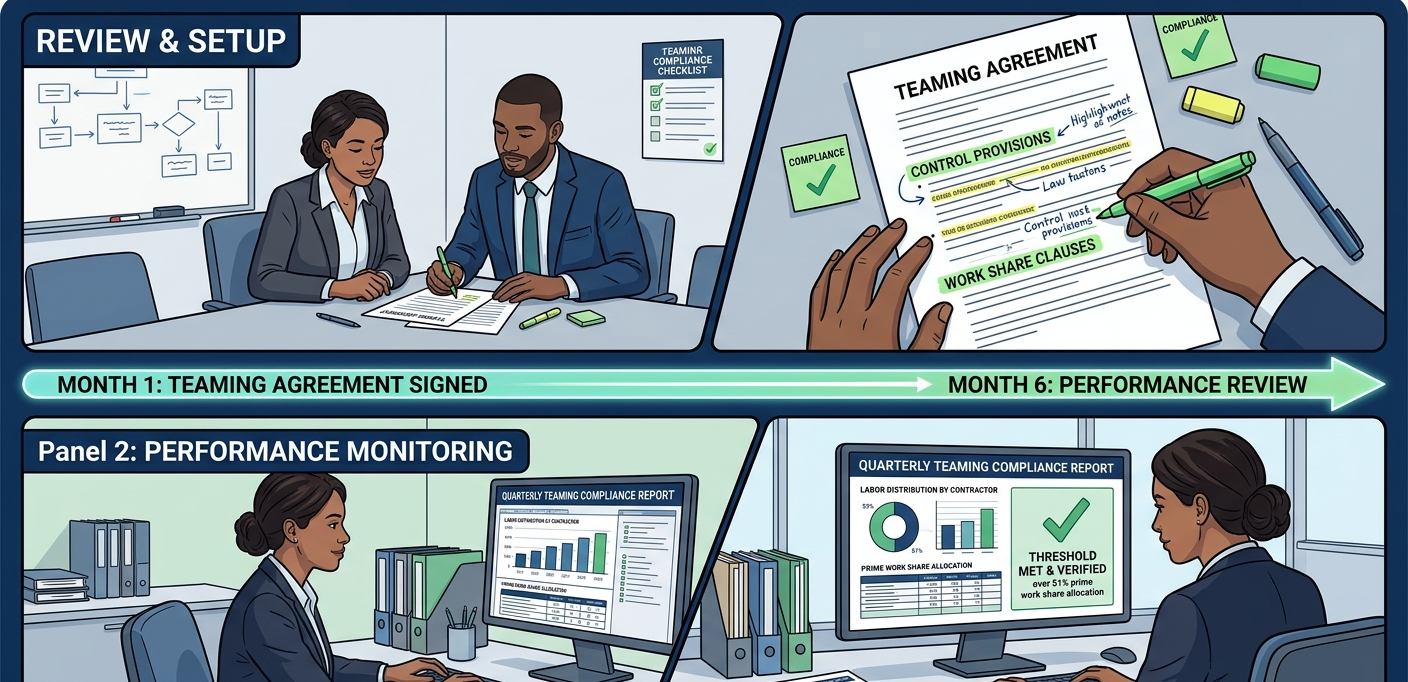
Step 2: Document your work share performance throughout contract execution. Don’t wait for the incurred cost submission to discover that your actual labor distribution has drifted from your teaming agreement’s work share provisions. Maintain a running record of hours and costs by contractor, tracked against your Limitations on Subcontracting threshold on a quarterly basis. If actual performance is trending below your required threshold, address it operationally before it becomes a cost certification problem. A DCAA-compliant timekeeping system that codes labor by contract and contractor gives you the real-time visibility to manage this proactively.
Step 3: Maintain genuinely independent accounting systems. If you are the subcontractor in a teaming arrangement, your accounting system must be operationally independent from the prime. Separate chart of accounts, separate indirect cost pools, separate timekeeping administration. The fact that you share office space or use a common project management platform doesn’t automatically create affiliation — but shared financial systems do create audit exposure. Document your system’s independence explicitly in your accounting system description.
Step 4: Review exclusivity and non-compete provisions carefully. Teaming agreements that prohibit the subcontractor from pursuing the same procurement independently, or from teaming with other primes on related work, can create economic dependence indicators that SBA and DCAA treat as affiliation evidence. Exclusivity provisions should be narrowly scoped to the specific procurement and performance period — not broadly written in ways that limit the subcontractor’s independent business development.
Step 5: Conduct a post-award teaming compliance review at the six-month mark. Six months into contract performance, revisit the teaming agreement against actual execution: are work shares being maintained as documented, are accounting systems operating independently, are management control provisions being applied in ways consistent with the agreement’s language? Document this review and resolve any gaps before they accumulate into a pattern that creates audit exposure. For guidance on structuring internal compliance reviews, see our post on building an internal audit function.
The Cost of Getting It Wrong
An affiliation finding by SBA on a small business set-aside contract can result in loss of the contract award, recertification requirements, and in cases involving knowing misrepresentation, suspension or debarment proceedings. Those consequences exist entirely outside the DCAA audit framework — but they trigger DCAA scrutiny of every cost submission filed under the affected contract.
The cost of a proper teaming agreement review and ongoing compliance monitoring — specialized legal review, quarterly work share tracking, and an independent accounting system — typically runs between $10,000 and $25,000 annually for a small contractor with an active teaming portfolio. That is a fraction of the value of a single set-aside contract award, and an even smaller fraction of the exposure created by an affiliation finding that voids one.
The math is straightforward. Structure the arrangement correctly before execution, monitor it actively during performance, and the teaming agreement becomes what it was designed to be — a competitive advantage, not a compliance liability.
Jurisdictional Notes
SBA affiliation rules under 13 C.F.R. Part 121 apply to all small business set-aside contracts across federal agencies — DoD and civilian alike. The Limitations on Subcontracting requirements under FAR 52.219-14 apply government-wide on small business set-asides, with specific thresholds varying by contract type. DCAA audit jurisdiction is primarily DoD-focused, but civilian agency audit organizations apply the same FAR cost accounting standards to teaming arrangements on civilian set-aside contracts. Contractors pursuing set-asides across both DoD and civilian agencies should apply a consistent teaming agreement compliance framework regardless of the awarding agency.
Teaming is a legitimate and powerful strategy for small contractors building their federal portfolio. The compliance risks embedded in poorly structured agreements are just as real as the business development benefits — and they surface at the worst possible time, when a contract is performing and the team is delivering. Structure the agreement right, monitor performance against it actively, and teaming becomes a durable part of your growth strategy rather than a source of audit exposure.
Hour Timesheet gives government contractors the timekeeping and cost tracking tools to maintain the independent labor records and work share documentation that compliant teaming arrangements require. See how our platform supports your subcontract compliance program.