
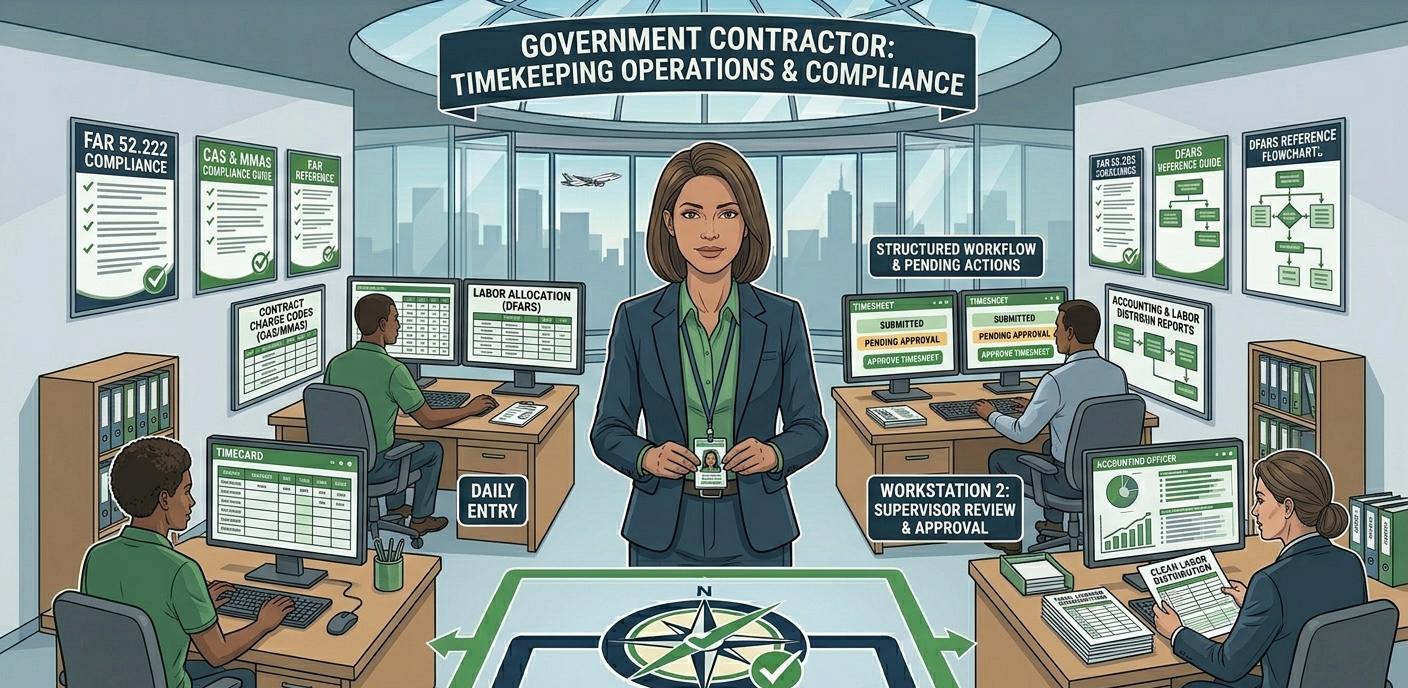
DCAA Audit Preparation for Government Contractors
DCAA audit preparation starts long before an auditor requests records. For government contractors, labor is often one of the most closely reviewed cost areas, which makes accurate timekeeping, clear charge codes, documented approvals, and organized records essential to audit readiness. Under FAR 31.201-2, contractors are responsible for maintaining records that show claimed costs were incurred, properly allocated, and supported. That is why strong government contract time tracking is both a compliance priority and an operational advantage. When daily processes are disciplined and consistent, organizations reduce rework, improve visibility into labor costs, and make audits far less disruptive.
What DCAA Audit Preparation Really Involves
DCAA audit preparation is not just about pulling reports at the last minute. It is the ongoing process of maintaining timekeeping and labor records that can stand up to review. The Defense Contract Audit Agency examines whether contractor records and internal controls support the costs charged to government contracts. For many firms, that means labor charging discipline is central to audit readiness because labor affects billing, indirect rates, and overall contract cost reporting.
A strong preparation process begins with understanding what auditors typically expect to see: daily time entry, proper segregation of direct and indirect labor, supervisor review, documented corrections, and accessible supporting records. The DCAA Contract Audit Manual reinforces the importance of internal controls and reliable source documentation, while DFARS accounting system criteria highlight the need for accurate cost accumulation and separation of cost objectives where applicable.
It is also important to be precise about terminology. No software is officially “DCAA certified.” Instead, contractors should look for DCAA compliance software that supports DCAA-aligned timekeeping practices, such as audit trails, approval workflows, and structured labor allocation. In practice, audit readiness depends on more than technology alone. Written policies, employee training, manager oversight, and consistent execution matter just as much as the system being used. When those elements work together, contractors are in a much better position to defend their labor records and respond confidently during an audit.
Practical Steps to Improve Audit Readiness
The most effective DCAA audit preparation strategies are usually the simplest to repeat every day. First, require employees to enter time daily rather than reconstructing it at the end of the week. Daily entry improves accuracy and reduces the risk of estimated hours being charged to the wrong contract, task, or indirect account. Second, make charge codes easy to understand. Employees should know exactly when to use direct labor, indirect labor, PTO, holiday, or other leave categories so total time accounting stays complete and consistent.
Third, document every timesheet correction with a visible audit trail. If an employee changes hours after submission, the organization should be able to show what changed, when it changed, and who approved it. Fourth, establish approval deadlines for supervisors. Prompt review helps catch miscoded labor before payroll or accounting exports create downstream problems. Fifth, train employees and managers regularly on timekeeping rules and retain records of that training as part of your compliance file.
Sixth, keep records organized and accessible in line with FAR Subpart 4.7 record retention requirements. Commonly requested records may include timesheets, approvals, leave balances, payroll support, and labor distribution reports. Seventh, perform internal self-checks. For example, review late submissions, edits after approval, unusual charging patterns, and leave mismatches before an auditor does. A practical scenario is an employee recording 40 project hours while HR separately tracks 8 hours of PTO in a spreadsheet. That inconsistency creates unnecessary risk. Integrated, disciplined processes prevent those issues and also improve productivity by reducing manual reconciliation and last-minute corrections.
How Better Time Tracking Supports Compliance and Productivity
For government contractors, the best compliance processes are also the most efficient ones. Strong government contract time tracking reduces administrative friction because employees record time once, managers approve it in a standard workflow, and accounting receives cleaner data. That matters in real operations. When timesheets are submitted late, leave is tracked in a separate system, or direct and indirect labor are coded inconsistently, teams spend valuable time fixing preventable errors instead of focusing on project execution.
A practical, audit-friendly workflow should support daily time entry, contract and task-level labor allocation, leave tracking, approvals, and reporting in one place. That is where Hour Timesheet’s DCAA-aligned approach is especially useful. The platform helps organizations manage employee time tracking, project and contract time tracking, and leave management within a structured system that supports complete labor records.
Hour Timesheet also helps streamline manager approvals and maintain audit-friendly records of time entry changes, which can strengthen audit readiness without adding unnecessary complexity. For organizations that need cleaner downstream processing, approved time can align more efficiently with payroll and accounting workflows through integrations such as QuickBooks time tracking integration. Just as important, Hour Timesheet includes setup, support, and training, which can help small and midsize contractors put better controls into practice faster. The result is a more consistent process that supports DCAA timekeeping expectations while improving day-to-day productivity.
Build a Stronger Audit-Ready Process
DCAA audit preparation is ultimately about consistency: accurate daily entries, correct labor charging, documented approvals, reliable audit trails, and organized records that support claimed costs. Government contractors that treat audit readiness as an everyday discipline are better positioned to reduce risk, improve reporting accuracy, and avoid the scramble that often comes with manual or disconnected processes.
Hour Timesheet helps organizations put those practices into operation with practical DCAA compliance software designed for government contract time tracking. By combining daily time entry, direct and indirect labor tracking, leave management, approval workflows, reporting, and payroll/accounting integration support, Hour Timesheet makes it easier to maintain compliant records and streamline administrative work at the same time. For contractors looking to strengthen audit readiness with a system built around usability and accountability, Hour Timesheet offers a focused solution backed by free setup, support, and training. To learn more, visit the Hour Timesheet contact page.