
Entertainment and Travel: Distinguishing Personal vs. Billable Costs
Your company’s VP of Business Development traveled to a conference mixing customer meetings with recreational activities, charging the entire $8,500 trip to indirect costs—airfare, hotel, meals, golf outing, spouse travel, and entertainment expenses. During your incurred cost audit, DCAA questioned $6,200 of these costs, identifying unallowable entertainment charges, excessive meal costs beyond per diem limits, spouse travel lacking business purpose, and personal time inappropriately charged as business travel requiring cost segregation that your expense reports didn’t provide. Here’s what contractors miss about entertainment and travel costs: federal cost principles draw sharp distinctions between legitimate business travel supporting operations and personal expenses, entertainment activities, or excessive costs that regulations explicitly prohibit charging to government contracts—you need detailed expense documentation segregating allowable business costs from unallowable personal or entertainment expenses, contemporaneous business purpose justification proving trip necessity, and cost reasonableness analysis demonstrating expenditures don’t exceed what prudent businesspersons would incur. Understanding how to document, classify, and defend travel and entertainment costs isn’t about restricting business development or employee benefits—it’s about ensuring only legitimate business expenses with clear operational purposes charge to government work while personal enjoyment, relationship-building entertainment, and excessive expenditures receive proper unallowable treatment preventing taxpayer subsidy of contractor lifestyle choices.
The Legal Framework Governing Travel and Entertainment Cost Allowability
Federal cost principles establish strict limitations on entertainment costs while permitting reasonable business travel expenses with proper documentation and justification. FAR 31.205-14 renders entertainment costs completely unallowable including costs of amusement, diversion, social activities, and associated costs such as tickets to shows or sporting events, meals provided at entertainment events, gratuities, and room rentals for entertainment purposes. This blanket prohibition means no entertainment costs are allowable regardless of business benefit claimed, customer relationships strengthened, or competitive necessity argued—entertainment represents unallowable cost category requiring absolute exclusion from government contract charging.
The travel cost allowability criteria under FAR 31.205-46 permit costs of transportation, lodging, meals, and incidental expenses for official company business when costs are reasonable and don’t exceed amounts established by organizational policy or Federal Travel Regulation limits for government employees performing similar travel. Understanding DCAA compliance requirements means recognizing that business travel costs require documentation proving trip business purpose, demonstrating cost reasonableness through comparison to applicable standards, and segregating personal time or expenses from business costs when trips combine business and personal activities.
The reasonableness standard under FAR 31.201-3 requires travel costs to reflect amounts prudent businesspersons would incur under comparable circumstances, considering factors including customary business practices, sound business judgment, and arm’s-length bargaining. This means first-class airfare when business class would suffice fails reasonableness tests, luxury hotel accommodations exceeding competitive rates lack justification, and excessive meal costs beyond established per diem rates represent unreasonable expenditures regardless of actual amounts spent. Reasonableness evaluation compares contractor expenditures to established benchmarks including Federal Travel Regulations, industry norms, and contractor’s own travel policies governing employee reimbursement.
The critical consideration involves FAR 31.205-6(m)(2), establishing that compensation for personal services includes benefits such as cost of living or housing allowances but distinguishes these from temporary duty travel which follows different allowability rules. This distinction prevents contractors from disguising compensation through inflated travel reimbursements or treating relocations as business travel, requiring clear classification between genuine temporary business travel versus personal moves, long-term assignments, or benefits masquerading as travel expenses.
What Contractors Must Understand About Entertainment and Travel Cost Challenges
Here’s what contractors miss about entertainment and travel: the line between business meals and entertainment isn’t determined by your intent or business benefit—it’s defined by FAR based on activity characteristics, with meals at entertainment events becoming unallowable entertainment costs even when substantive business discussions occur. DCAA compliance explained emphasizes that classification depends on regulatory definitions rather than contractor judgment about business value, with prohibited entertainment including any social activity or amusement regardless of business conducted during events.
The entertainment meal trap emerges when contractors charge meals to business entertainment assuming business discussion makes costs allowable, but FAR treats meals provided during entertainment events as entertainment costs regardless of business content. This is where audits go sideways—your golf outing with customers where you discussed contract opportunities involves unallowable entertainment (golf) and unallowable meals (provided at entertainment event) even though legitimate business discussions occurred. The business value doesn’t overcome regulatory prohibition on entertainment and associated meal costs, requiring complete exclusion from allowable costs despite genuine business benefits contractors believe justify expenditures.
The spouse travel justification challenge surfaces when employees bring family members on business trips and charge their travel costs to company expenses. Spouse travel is allowable only in rare circumstances where spouse performs bona fide company services during trip, not merely accompanies employee or provides social presence at customer events. DCAA timekeeping requirements extend conceptually to spouse travel requiring documented evidence of specific services performed, time records showing work activities, and deliverables demonstrating productive contribution rather than just social participation. Without compelling documentation proving genuine business services, all spouse travel costs are unallowable regardless of networking value or customer relationship benefits claimed.
The mixed business-personal trip allocation problem appears when travel combines legitimate business purposes with personal vacation or recreational activities, requiring cost segregation between business and personal components. Your employee traveling to California for three-day customer conference who extends trip four additional days visiting family must allocate costs appropriately—airfare might allocate based on business versus total trip duration, hotel charges only for business nights, meals and incidentals only for business days, with personal time costs completely excluded from company reimbursement and contract charging. Failure to segregate creates the questioned costs when entire trip charges as business travel despite substantial personal benefit requiring cost allocation.
The per diem versus actual cost decision creates compliance considerations when contractors reimburse actual meal costs rather than using per diem rates, requiring receipts and business purpose documentation for amounts exceeding federal per diem limits. While contractors can establish their own travel policies, costs exceeding Federal Travel Regulation per diem rates face reasonableness scrutiny requiring justification that higher costs represent necessary expenditures rather than excessive spending. When your employee incurs $150 in meal costs daily in a location with $69 federal per diem, you need documentation explaining why costs more than doubled reasonable amounts—otherwise excess represents unreasonable expenditure requiring unallowable classification.
The conference and training cost confusion emerges when contractors conflate education/training costs with travel expenses, applying different allowability standards depending on classification. Conference registration fees, course tuition, and materials typically follow training cost rules under FAR 31.205-44 which are generally allowable when job-related, while travel to conferences follows travel cost rules requiring business purpose and reasonableness documentation. Conference social events, spouse programs, and recreational activities represent entertainment regardless of conference setting, requiring segregation from allowable conference registration and travel costs.
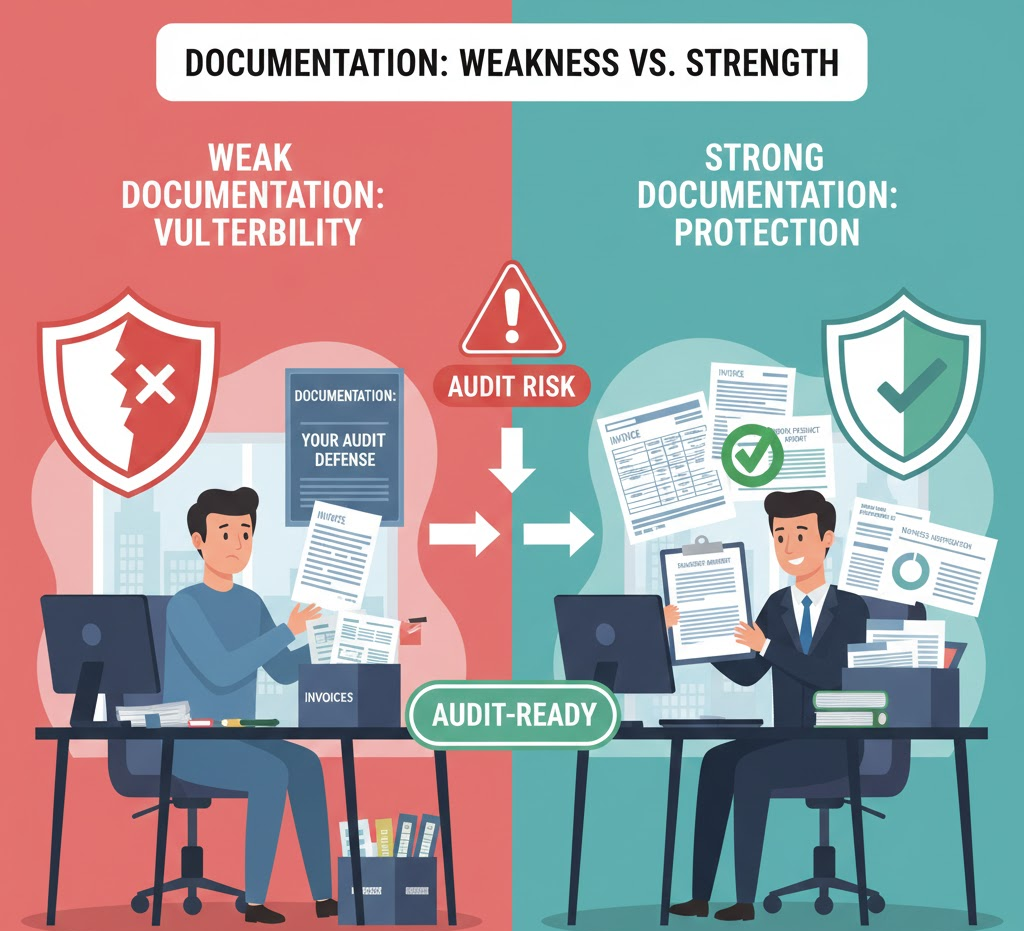
The documentation timing and detail inadequacy becomes apparent when expense reports lack contemporaneous business purpose descriptions, itinerary details supporting business versus personal time allocation, or receipts substantiating claimed expenditures. Generic expense descriptions like “customer meeting—meals $200” provide insufficient documentation compared to detailed records: “Dinner meeting with ABC Corp procurement director John Smith and contracting officer Jane Doe at Restaurant XYZ, discussed Contract 123 modification requirements and FY25 procurement plans, $185 total.” Detail transforms generic expense claims into defensible business documentation supporting allowability verification.
Five Essential Steps for Compliant Travel and Entertainment Cost Management
Step 1: Establish Clear Written Travel and Entertainment Policies
Develop comprehensive travel policy documenting company standards for allowable business travel including: approved travel purposes and authorization procedures, transportation class restrictions (economy/business class), lodging cost limits by location or federal per diem rates, meal reimbursement methodology (per diem or actuals with limits), incidental expense allowances, and spouse/family travel prohibitions except rare circumstances with explicit approval. Written policies provide both employee guidance and audit documentation demonstrating organizational standards preventing excessive or unreasonable expenditures.
Create explicit entertainment cost policy establishing that all entertainment expenses are unallowable for government contract charging regardless of business benefit, defining entertainment broadly to include sporting events, theater, concerts, golf, recreational activities, and meals at entertainment venues. Policy should require employees to identify entertainment expenses on expense reports enabling proper unallowable classification, prohibit charging entertainment to company accounts used for government work, or implement personal payment of entertainment with no reimbursement avoiding accounting system complications.
Implement policy exception procedures requiring executive approval for travel or expenses exceeding policy limits, with written justification explaining business necessity for excess costs. Exception approvals document that extraordinary expenditures result from genuine business needs rather than employee preference or lack of cost consciousness, supporting reasonableness defenses when auditors question costs exceeding normal limits.
Step 2: Deploy Detailed Expense Report Requirements with Business Purpose Documentation
Require comprehensive expense reports documenting: trip purpose and business objectives, detailed itinerary showing business activities each day, names and titles of customers or business contacts met, specific topics discussed or business conducted, cost breakdowns by category with receipts, and segregation of any personal time or expenses from business costs. Detailed reporting transforms generic expense claims into defensible business documentation supporting both payment approval and audit verification.
Implement contemporaneous documentation requirements mandating expense report submission within 30 days of trip completion while details remain fresh and supporting receipts are available. Delayed reporting creates documentation challenges when employees cannot remember trip details months later, missing receipts cannot be reconstructed, and business purpose descriptions become generic summaries rather than specific activity descriptions. Timely reporting enables accurate documentation while trip circumstances remain clear.
Establish business purpose validation procedures requiring supervisors to verify reported business purposes align with known business needs, customer relationships, and organizational objectives before approving expense reimbursements. Management review provides oversight ensuring expense claims represent legitimate business activities rather than personal travel masquerading as business trips, demonstrating cost consciousness and fiduciary responsibility that auditors expect.
Step 3: Implement Systematic Entertainment and Unallowable Cost Identification
Deploy expense report design requiring employees to explicitly identify entertainment expenses on dedicated form sections or using specific expense codes, enabling automated unallowable cost classification without requiring accounting staff judgment about individual expenses. Clear identification at employee reporting rather than accounting review prevents the classification errors that occur when accountants must interpret ambiguous expense descriptions determining entertainment versus allowable business costs.
Create unallowable cost account structure with dedicated general ledger accounts for entertainment expenses, spouse travel, excessive costs, and other unallowable travel categories, enabling systematic cost segregation from allowable business travel included in indirect pools. Dedicated accounts provide visibility into unallowable cost totals while supporting verification that these amounts properly exclude from indirect rate calculations and government contract charging.
Implement automated controls preventing entertainment account charges from allocating to indirect pools, flagging unusual expense patterns suggesting potential entertainment misclassification, and generating exception reports identifying expenses requiring additional review or documentation before final approval. Automated controls provide ongoing monitoring detecting potential unallowable cost charging before problems accumulate into material audit findings.
Step 4: Establish Mixed Business-Personal Trip Allocation Procedures
Develop allocation methodologies for trips combining business and personal activities, documenting how costs segregate between business and personal portions including: transportation allocation based on business versus total trip days, lodging charges only for business nights, meals and incidentals only for business days, and rental car allocation based on business versus personal usage. Written methodologies ensure consistent application while supporting audit defense when DCAA examines mixed-purpose trip allocations.
Require employees to identify mixed-purpose trips on expense reports, provide detailed itineraries segregating business and personal days, and calculate cost allocations following established methodologies before submitting for approval. Employee-level allocation with supervisor review ensures proper cost segregation occurs contemporaneously rather than requiring accounting staff to reconstruct trip details and apply allocations retrospectively from inadequate information.
Implement conservative allocation approaches when precise segregation proves difficult, favoring personal rather than business classification for ambiguous costs. When your employee’s three-day business trip includes one day potentially personal, allocating two days business and one day personal rather than claiming all three as business demonstrates cost consciousness while reducing audit risk from aggressive allocation interpretations.
Step 5: Maintain Comprehensive Travel Cost Documentation and Reasonableness Analysis
Create travel documentation files consolidating: trip authorization and business purpose justification, expense reports with receipts, itineraries showing business activities, customer meeting confirmations or correspondence, conference agendas and materials, and any deliverables or work product resulting from trip. Comprehensive files provide efficient audit support while demonstrating systematic approach to travel cost documentation and management.
Conduct periodic travel cost reasonableness analysis comparing contractor expenditures to applicable benchmarks including Federal Travel Regulation per diem rates, average commercial airfares for routes traveled, and typical hotel costs in visited locations. Analysis demonstrating costs generally align with benchmarks supports reasonableness while identifying outlier expenses requiring additional justification or policy modification preventing future excesses.
Implement pre-submission review of travel costs before incurred cost proposal preparation, examining major expenses for documentation adequacy, identifying potential unallowable costs requiring reclassification, and ensuring proper segregation between allowable business travel and unallowable entertainment or personal expenses. Pre-submission review catches issues enabling proactive correction rather than reactive response to audit questions about inadequately documented or improperly classified costs.
The Investment in Travel and Entertainment Compliance
Implementing comprehensive travel and entertainment compliance procedures costs between $5,000 and $18,000 for small to mid-sized contractors including policy development, expense system configuration, training delivery, and procedure documentation. Annual maintenance costs typically run $2,000 to $8,000 for ongoing policy updates, employee training, and compliance monitoring. These investments prevent the substantial questioned costs from unallowable entertainment charges, excessive travel expenses, or inadequately documented business purposes.
Let me show you the value: contractors with proper travel cost management recover legitimate business travel expenses through detailed documentation supporting allowability while systematically excluding entertainment and personal costs preventing audit findings. They demonstrate cost consciousness and fiduciary responsibility that auditors recognize through reasonable expenditures aligned with policy limits and federal benchmarks. They avoid the extensive questioned costs when DCAA discovers entertainment charges, spouse travel, or excessive costs improperly included in indirect pools.
Contractors with inadequate travel cost management face wholesale disallowance of entertainment expenses when golf outings, sporting events, or social activities charge to business accounts, experience questioned costs when spouse travel or personal trip components charge as business expenses, and suffer documentation challenges when generic expense reports cannot support business purpose claims or cost reasonableness assertions. They discover that casual expense practices create both compliance violations and missed opportunities for operational cost control.
Understanding Travel and Entertainment Requirements Across Contract Types
Travel and entertainment cost limitations apply uniformly when costs charge to cost-reimbursement contracts or allocate through indirect rates affecting government work. The absolute prohibition on entertainment costs applies regardless of contract type, customer agency, or business benefit claimed, with FAR requirements consistent across Department of Defense, NASA, Department of Energy, and civilian agencies.
Business travel cost allowability follows consistent standards across agencies, though specific per diem rates and reasonableness benchmarks may vary by location and agency-specific travel regulations. Contractors supporting multiple agencies should apply most restrictive standards across all government work ensuring comprehensive compliance rather than attempting agency-specific differentiation creating administrative complexity and cross-charging risks.
Your Path to Travel and Entertainment Cost Compliance
The travel and entertainment landscape rewards contractors who invest in clear policies, detailed documentation requirements, and systematic unallowable cost identification rather than treating expense reimbursement as routine administrative function lacking compliance significance. DCAA evaluates travel costs through detailed expense record review, business purpose verification, and reasonableness analysis comparing costs to applicable benchmarks.
For contractors seeking travel compliance support, Hour Timesheet provides labor tracking documenting employee work activities supporting business travel justification, time-based evidence of trip business purposes, and work product demonstrating productive outcomes from business travel investments. Our systems provide contemporaneous activity records complementing expense documentation.
Your business travel investments deserve documentation proving legitimate business purposes at reasonable costs while entertainment and personal expenses receive proper unallowable treatment. Implement systematic procedures ensuring expense management supports both operational objectives and compliance requirements.