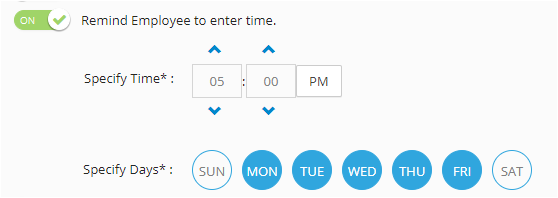
Since the Defense Contract Audit Agency (DCAA) mandates daily timesheet entries for each employee, Hour Timesheet ensures compliance by providing daily timesheet reminders. This feature is particularly useful for employees who may forget to complete their time entries on a daily basis. By adhering to the DCAA requirement, Hour Timesheet streamlines record-keeping and helps businesses maintain compliance effortlessly.
Hour Timesheet’s Daily Timesheet Reminder feature is designed to simplify and streamline the process of tracking employee hours. The software automatically generates Timesheet Reminders for Employees for those users who don’t enter time daily.
Daily Timesheet Reminders: Never miss a timesheet submission again. Our system sends out Daily Timesheet Reminders, ensuring that they record their hours accurately and on time.
Compliance Features: Our system is built to help you comply with labor laws and regulations, avoiding potential fines and legal issues.
User-Friendly Interface: We’ve designed our platform to be easy for everyone in your organization to use, regardless of their tech proficiency.
Time-Saving Automation: No more chasing after employees for their timesheets – our system does the work for you.
Customizable Reports: Generate detailed reports tailored to your specific needs, helping you make data-driven decisions.
Integration Capabilities: Seamlessly integrate Hour Timesheet with your existing HR and payroll systems such as ADP or Gusto
Mobile Access: Employees can submit their timesheets from anywhere using our mobile app.
Customer Support: Our dedicated support team is always ready to assist you with any queries or issues.
Are you ready to experience the benefits of Hour Timesheet’s Daily Timesheet Reminder feature? Sign up for a free trial today and see the difference it can make in your business.
Understanding DCAA Compliance Definition and Importance of DCAA Compliance The Defense Contract Audit Agency (DCAA) is a federal agency responsible for auditing contracts for the Department of Defense (DoD) and other federal agencies. Its primary role is to ensure that government funds are spent appropriately through thorough audits, which assess whether contract costs are allowable,…
Navigating the intricacies of SBIR (Small Business Innovation Research) and STTR (Small Business Technology Transfer) audits is crucial for businesses participating in these vital government programs. Compliance with audit requirements ensures that companies can continue to receive funding and support for their innovative projects. Central to this compliance is accurate and meticulous timekeeping, particularly in…
Hour Timesheet’s innovative software solutions are designed to facilitate effective audit trails, offering features that enhance accuracy, transparency, and accountability. By integrating robust tools like time tracking and job costing, Hour Timesheet empowers organizations to meet stringent compliance standards while streamlining their operational workflows. Understanding Comprehensive Audit Trails Audit trails are essential components in timekeeping…
DCAA Timekeeping Hour Timesheet Timesheet Sections The “My Timesheet” can be subdivided into 4 sections Clock In/Clock Out – this section is OPTIONAL Hours Worked – this section is required for QuickBooks timesheet integration and Gusto Payroll Integration Notes/Summary – section for entering daily hours worked notes or viewing leave balance data or timesheet summary…
As a government contractor, managing your indirect rates is of utmost importance if you want to bid on government contracts. However, keeping track of indirect rates can be a daunting task, especially for small businesses without sophisticated accounting systems. In this blog post, we will dive into how Hour Timesheet can help small businesses manage…
Efficient leave time management is crucial for government contractors, particularly those new to DCAA compliance, as it directly impacts payroll accuracy, project timelines, and regulatory adherence. For small to medium-sized enterprises, navigating the complexities of various leave types—such as vacation, sick leave, and personal time—poses significant challenges, especially when managed manually. Automating leave time tracking…